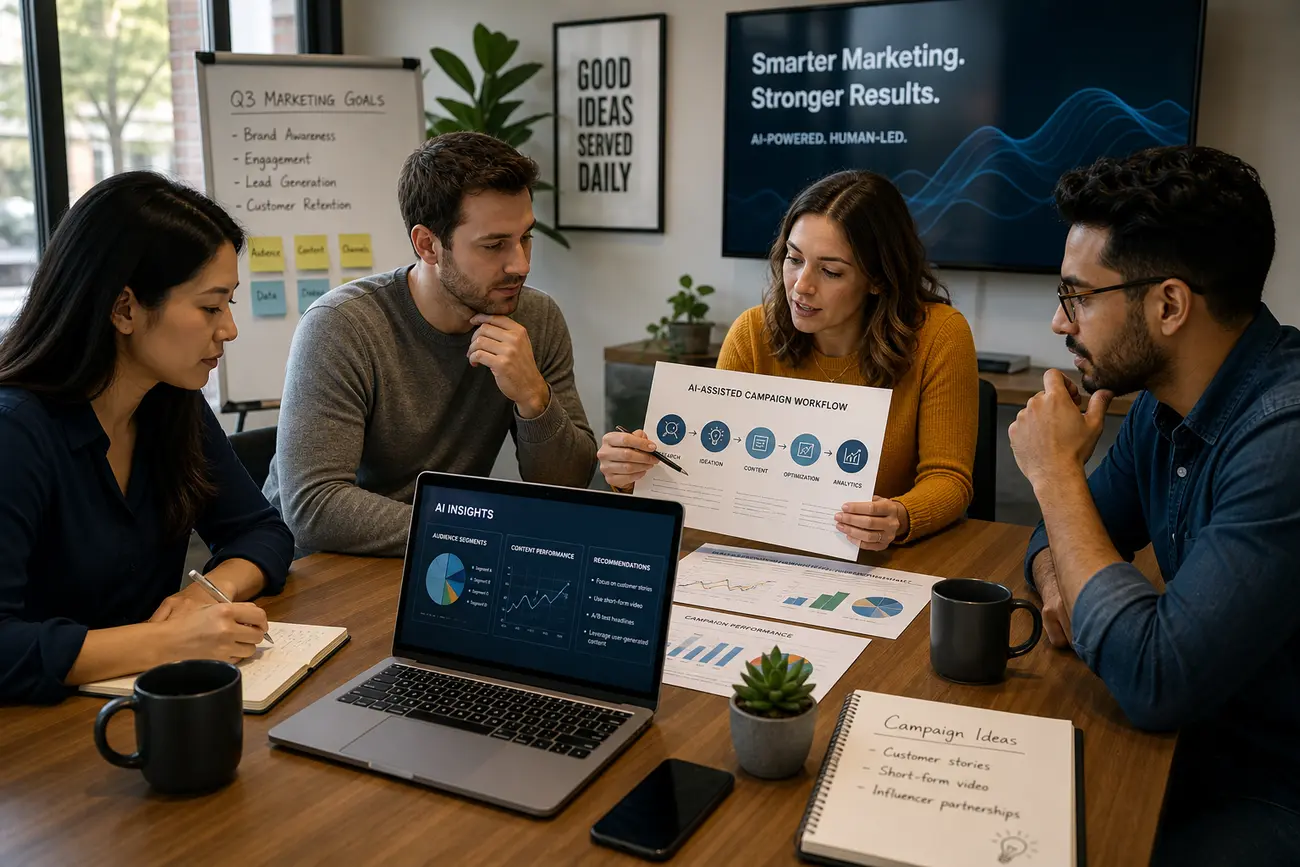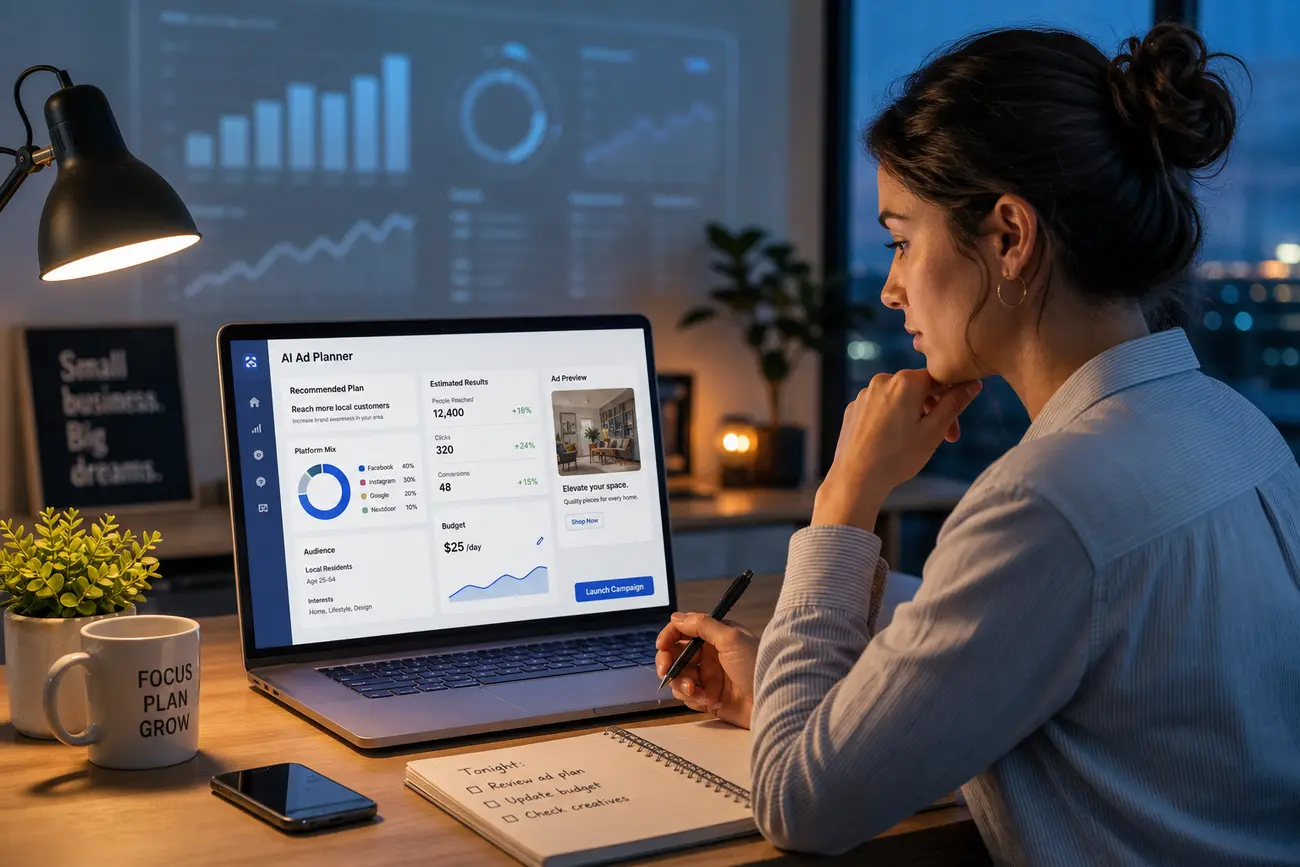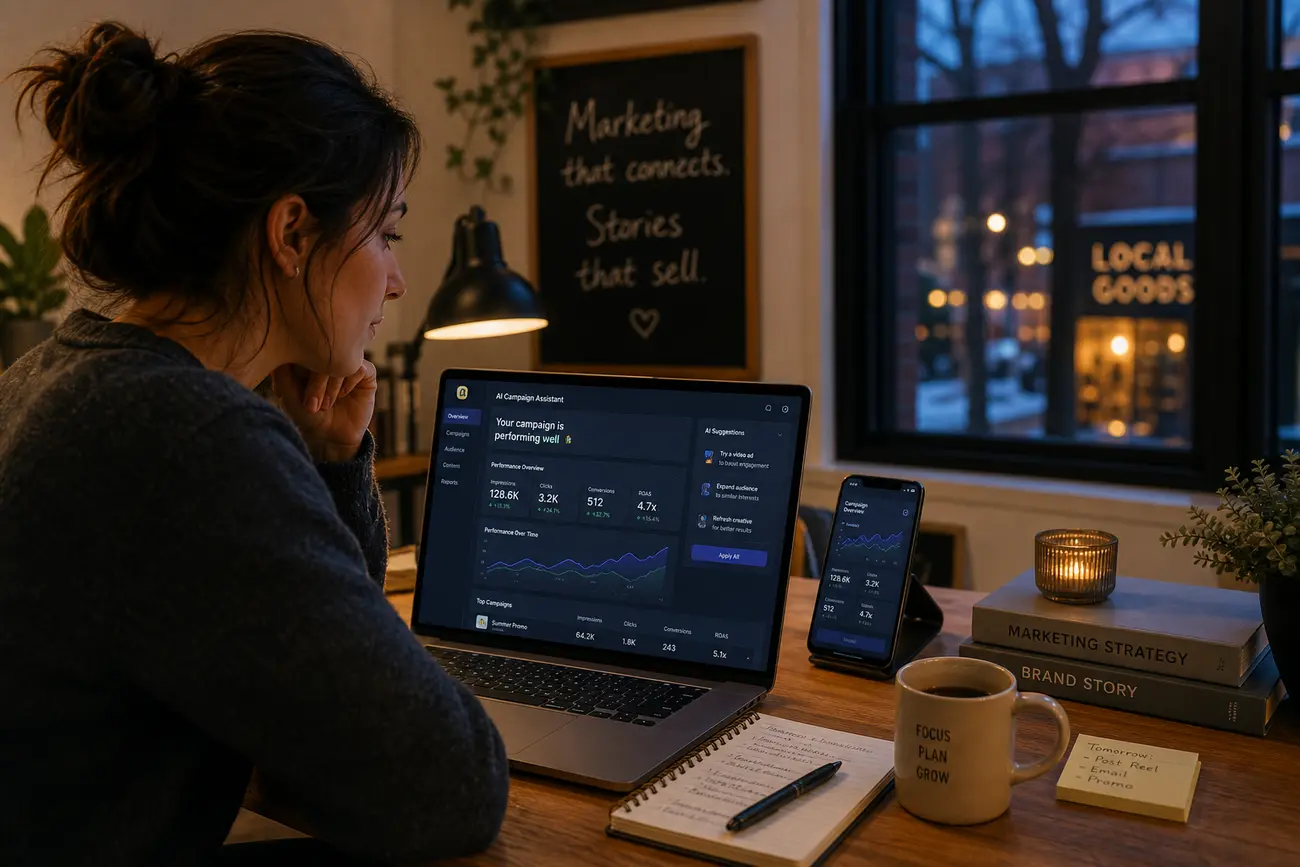
For a busy small-business owner, instagram and facebook ads can feel like a second job: offers to write, audiences to choose, budgets to protect, and reports to understand. The good news is that you do not need to become a full-time media buyer to run profitable campaigns, but you do need a repeatable AI-supported workflow that keeps your strategy, creative, tracking, and decisions organized.
Why Manage Instagram and Facebook Ads Yourself with AI
DIY Meta advertising makes sense when your budget is limited, your offer is simple, and you need speed: local services, ecommerce product tests, booking campaigns, lead forms, or message-based sales. If you know your customers better than anyone, AI can help turn that knowledge into campaigns faster.
AI can support audience research, offer positioning, ad copy, creative variations, checklists, reporting, and performance analysis. It should not replace your judgment. You still approve the strategy, budget, creative claims, tracking setup, and follow-up process. Compared with hiring an agency, managing instagram and facebook ads yourself gives you more control and faster learning, though less specialist execution.
Build the Campaign Plan Before You Run Meta Ads
Before you run meta ads, choose one measurable goal: leads, purchases, bookings, messages, traffic, or awareness. Then match the Meta objective to that goal, such as Leads, Sales, Engagement, Traffic, or Awareness. A clear objective prevents vague campaigns that spend money without proving business value.
Use AI to create a short campaign brief: target customer, pain points, promise, proof, objections, call to action, budget, and testing period. For small businesses, one focused daily budget usually beats spreading money thinly across many campaigns. Also set up tracking early: Meta Pixel, Conversions API, UTM links, CRM tags, lead form fields, and a weekly KPI dashboard.
If you are comparing Meta with Google, $20 a day can also be enough for a narrow Google Ads test, but costs depend on keyword competition and intent. There is no fixed cost to “do a Google ad”; you usually pay by click, impression, or conversion. Google Ads does not pay advertisers per 1,000 views; advertisers pay for views or impressions in auctions. To stop Google Ads on your phone, open the Google Ads app, select the campaign, and pause or remove it. For a deeper workflow, see How to Manage Google Ads with AI Without a Campaign Manager.
Use AI to Research Audiences, Offers, and Competitors
Ask AI to build customer personas from your product, location, price point, best customers, and common objections. Good prompts reveal buying triggers: urgency, trust, convenience, status, savings, fear of loss, or a specific problem the customer wants solved now.
Then review competitor ads manually in Meta Ad Library. Paste your notes into AI and ask it to summarize repeated hooks, offers, formats, proof points, and gaps. Turn the research into testable angles: discount, social proof, comparison, local trust, before-and-after, founder story, product demo, or educational content.
Avoid over-targeting. One of the most important meta ads best practices is to give Meta enough room to learn, then guide the algorithm with strong creative, clear conversion signals, and clean tracking.
Create Ad Copy and Visuals That Follow Meta Ads Best Practices
Use AI to generate several ad concepts, not one “perfect” ad. Ask for short primary text, headlines, descriptions, opening hooks, objections, and calls to action. Test 3–5 creative angles at a time so you can learn clearly instead of launching dozens of random variations.
Strong instagram and facebook ads are mobile-first: the first three seconds are clear, text is readable, the offer is visible, and each ad has one main message. Useful formats include Reels, Stories, carousel ads, image ads, testimonials, product demos, short founder-led clips, and customer problem-solution videos.
For organic Instagram, frameworks like 5-3-2 or 5-3-1 remind you not to post only sales messages. Balance value, relationship-building, community content, and promotion. Paid ads can be more direct, but they still perform better when they feel helpful and specific.
Launch Your First Campaign Step by Step in Meta Ads Manager
In Meta Ads Manager, the basic flow is: choose campaign objective, buying type, budget, audience, placements, optimization event, schedule, and ads. Beginners should usually start with Advantage+ placements unless they have strong creative designed for only Reels, Stories, or Feed.
Choose the conversion path based on buyer behavior. Use website conversions for purchases or booked calls, instant forms for simple lead generation, Messenger or WhatsApp for conversation-led sales, and catalog campaigns for ecommerce stores with product feeds.
- Pre-launch checklist: Pixel and events active, Conversions API checked, URL tested, lead form submitted, spelling reviewed, offer accurate, mobile landing page working, payment method valid.
- Safe changes: pause, edit, duplicate, or stop ads in Ads Manager or the Meta Ads mobile app, but avoid constant changes during early learning.
Monitor Performance Without Overreacting Too Early
Measure the metric that matches your goal: cost per lead, cost per purchase, ROAS, booked calls, CTR, CPM, CPC, frequency, conversion rate, and lead quality. Followers and views matter only when they support revenue, trust, or future conversions.
Meta campaigns need learning time. Changing budgets, audiences, or ads too often can weaken results. A practical rhythm is to check spend daily, review performance weekly, compare creative results, and document decisions. You can paste campaign data into AI and ask for plain-English insights, likely problems, and the next three actions.
Improve Campaigns with AI-Led Testing and Optimization
Optimization is a loop: diagnose, form a hypothesis, change one variable, measure, and scale carefully. If cost per result is high, the problem might be weak creative, a poor offer, slow landing page, broad promise, low trust, or low-quality leads.
Use AI to create test plans, summarize results, and write new variations from winning hooks. Common fixes include refreshing creative, improving landing page speed, adjusting the offer, refining lead form questions, retargeting warm audiences, and excluding poor-fit leads. If you need better post-click performance, this guide on building a high-converting landing page for leads is a useful next step.
Do not chase cheap clicks, publish generic AI copy, ignore comments, send traffic to weak pages, or scale before profitability. The best meta ads best practices are boring but powerful: clear offer, clean data, steady testing, and honest numbers.
When to Keep DIY Management and When to Hire Help
Keep managing instagram and facebook ads yourself when cost per result is stable, tracking is clear, creative production is consistent, and you have time for weekly reviews. DIY works best when you can learn from the data and improve the offer quickly.
Hire a freelancer, consultant, or agency when funnels are complex, budgets are large, tracking is broken, creative testing is too slow, or campaigns stay unprofitable. You can also buy targeted help: an account audit, tracking implementation, AI prompt setup, creative review, or monthly coaching. Even with outside help, keep account access, data ownership, and transparent reporting.
FAQ
Can I hire someone to run my Instagram?
Yes. Just separate organic Instagram management from paid Meta campaign management. Define deliverables clearly: content calendar, posts, Reels, community management, reporting, or ad support.
Can I pay someone to manage my Instagram ads?
Yes. Hire a freelancer, consultant, or agency when your budget, tracking complexity, or time constraints justify it. Keep admin access and require clear performance reporting.
What is the 5 3 2 rule on Instagram?
The 5-3-2 rule is a content mix: five valuable posts, three relationship or community posts, and two promotional posts. It helps prevent constant selling.
What is the 5 3 1 rule on Instagram?
The 5-3-1 rule is a similar planning framework: mostly helpful content, some engagement-building content, and limited direct promotion. The point is balance.
How many followers on Instagram do you need to make $1000 per month?
There is no fixed number. A small trusted audience with a strong offer can outperform a large passive audience. Conversion rate matters more than follower count.
How to do influencer marketing on Instagram?
Choose creators whose audience matches your buyer, review engagement quality, agree on deliverables, use tracking links or codes, and measure leads, sales, or booked calls.
Is $20 a day good for ads?
Yes, $20 per day can be enough for a focused Meta test, especially for leads or local offers. Results depend on market, objective, offer, and tracking.
How much does it cost to run ads online?
Costs vary by platform, competition, and goal. For instagram and facebook ads, judge cost by business outcomes: cost per lead, purchase, booked call, or profitable sale.
Share Article
Your Digital Edge, Fully Automated
Spin up a cutting-edge website in minutes and preview it free - no signup, no credit card. Then keep growing it with MR.ROBOT's AI pipeline that writes, optimizes, and publishes SEO articles straight from your phone.
No signup. No credit card. You only pay when you love the result.