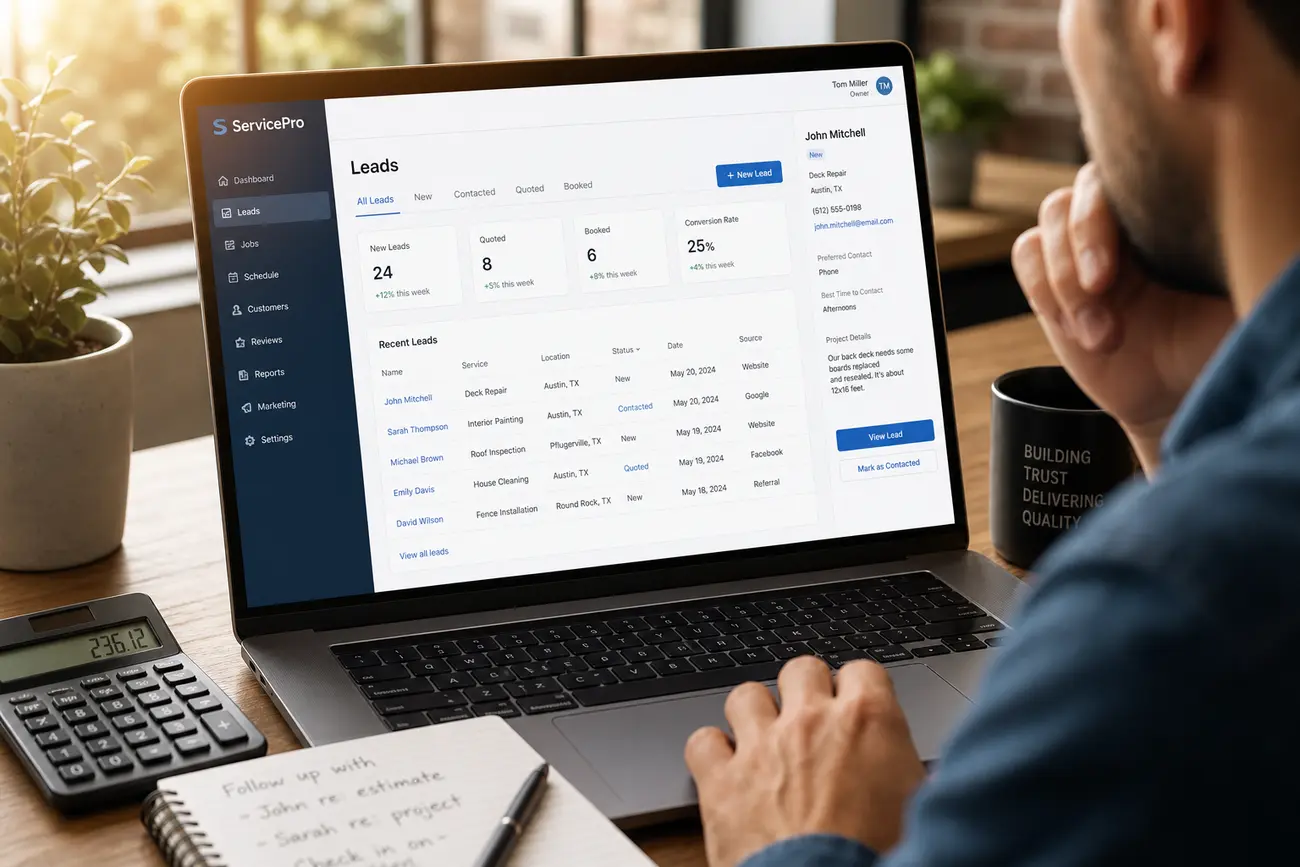
A lead generation landing page is not a digital brochure; it is a focused conversion system built around one clear audience, one valuable offer, and one easy next step. In this guide, you’ll learn how to plan, structure, and improve a website that attracts the right visitors and turns them into qualified leads.
Start with the Lead You Actually Want to Capture
Before designing pages, writing copy, or choosing tools, define what a qualified lead means for your business. A lead is not just someone who fills out a form. A good lead has a real problem, fits your target customer profile, has some level of budget or authority, and is ready for the next step you offer.
Clarify the buyer’s problem, urgency, buying stage, and preferred contact method. A homeowner looking for an emergency repair behaves differently from a B2B buyer researching vendors for next quarter. Your website should reflect that difference.
Choose one primary conversion goal for each page: a consultation request, quote form, demo booking, WhatsApp message, phone call, or lead magnet download. The offer should also filter for quality. “Get a free website audit for service businesses generating at least 20 leads per month” is more qualifying than “Contact us.”
Build a Lead Generation Landing Page Around One Clear Offer
A high-performing lead generation landing page is built around a single promise, a specific audience, and one call to action. Visitors should immediately understand who the page is for, what outcome they can expect, and what to do next.
Place the value proposition, proof, and CTA near the top of the page. Then use benefit-led copy to explain the outcome, not just the service features. Instead of saying “custom CRM implementation,” say “capture every website inquiry and follow up before competitors do.”
Keep forms short at first. Ask for only what you need to start the conversation: name, email, phone, company, or project type. You can collect deeper qualification details after the lead shows intent. For high-intent visitors, include alternate paths such as click-to-call, live chat, WhatsApp, or calendar booking.
Create a Website Structure That Guides Visitors Toward Conversion
When you are creating a lead generation website, the homepage should not try to close every visitor at once. Use it to segment people by service, problem, industry, or goal, then direct them to the most relevant page.
Build dedicated service pages for high-intent search queries and connect each page to a relevant conversion action. A pricing page, comparison page, case study, or FAQ section can reduce hesitation before someone contacts you. Navigation should stay simple, with clear CTAs that match the visitor’s stage: “Get a quote,” “Book a demo,” “Download the guide,” or “Talk to an expert.”
Avoid sending paid or SEO traffic to generic pages when a focused lead generation landing page would convert better. If the visitor searched for a specific service, give them a page that answers that exact need.
Use Trust Signals That Make Visitors Comfortable Taking Action
People do not submit contact forms just because a page looks good. They take action when the page reduces risk. Add testimonials, reviews, case studies, certifications, client logos, guarantees, and clear business contact details where they naturally support the buying decision.
Show real examples when possible: deliverables, timelines, before-and-after outcomes, sample reports, project stages, or screenshots. Explain what happens after the form is submitted, such as “We’ll review your request and respond within one business day.” This simple detail can increase confidence.
Near forms, include privacy reassurance, especially if you ask for phone numbers, budgets, or business details. Transparent pricing cues or package ranges can also qualify serious buyers and prevent unfit inquiries from filling your pipeline.
Learn from Lead Generation Website Examples Without Copying Them
The best way to study lead generation website examples is not to copy their design. Instead, analyze their offer clarity, page flow, CTA placement, proof points, and friction points. Look at how often they repeat the same action and how they remove distractions.
Compare examples across local services, B2B services, SaaS, agencies, consultants, and ecommerce lead capture funnels. Common patterns include quote requests, free assessments, audits, calculators, downloadable guides, comparison tools, and booking flows. Interactive tools can be especially useful because they help prospects self-qualify; for example, see how website calculators can generate qualified leads.
Use competitor research to find gaps you can improve: clearer pricing, stronger proof, faster pages, better FAQs, easier contact options, or a more specific promise. Your goal is not to look like everyone else; it is to make the decision easier for your ideal customer.
Connect SEO, Digital Marketing Platforms, and CRM Tools to Your Lead Funnel
SEO services help your website become visible in search through technical optimization, keyword strategy, content, local SEO, link earning, and performance tracking. SEO is not dead; it is evolving toward helpful content, better user experience, authority, local visibility, and AI-influenced search results.
The top digital marketing platforms for many lead generation businesses are Google Search, Google Business Profile, Meta platforms, LinkedIn, and email or CRM platforms. The best marketing platform for a small business depends on customer intent. Google is often strongest when people are actively searching, while social platforms can build awareness and support retargeting.
Connect every form, chat, WhatsApp click, call, and booking calendar to a CRM so leads are not lost after conversion. You do not need an LLC to do digital marketing campaigns, although a formal business structure may help with liability, banking, contracts, and taxes. Free CRM plans can be enough at the start, then you can upgrade as lead volume and follow-up complexity increase.
Track Performance and Improve the Website Every Month
A lead generation landing page should be measured by more than traffic. Track conversion rate, lead quality, source, cost per lead, form completion rate, call clicks, WhatsApp clicks, and booked meetings. Set up analytics, conversion events, call tracking, and CRM source attribution before you drive serious traffic.
The 80/20 rule for SEO and conversion is simple: a small number of pages, keywords, and improvements usually create most of the results. Improve the pages, offers, and traffic sources that produce the highest-quality leads first. For a deeper measurement framework, review these lead generation landing page metrics.
Review heatmaps, form drop-offs, search queries, and sales feedback every month. Test headlines, CTAs, form fields, proof sections, and offers before redesigning the whole website. Consistent small improvements often outperform occasional large rebuilds.
FAQ
What are SEO services?
SEO services improve a website’s visibility in search engines through technical optimization, keyword research, content planning, on-page optimization, local SEO, link earning, and performance tracking.
Is SEO dead or evolving in 2026?
SEO is evolving, not dead. In 2026, successful SEO depends more on helpful content, strong user experience, topical authority, local visibility, trusted brands, and search results influenced by AI summaries and answer engines.
Can I do SEO myself?
Yes. You can handle basics such as keyword research, page titles, content updates, internal links, and Google Business Profile optimization. Expert help is useful for technical SEO, competitive markets, and advanced content strategy.
What is the 80/20 rule for SEO?
The 80/20 rule means a small group of pages, keywords, and improvements often drive most traffic and leads. Focus first on the opportunities with the highest business impact.
What is the 3-3-3 rule in marketing?
The 3-3-3 rule is a messaging discipline: quickly communicate who you help, what problem you solve, and what action the visitor should take. It is especially useful on a lead generation landing page.
What are the top 5 digital marketing platforms for lead generation?
The top five to evaluate are Google Search, Google Business Profile, Meta platforms, LinkedIn, and email or CRM platforms. The best mix depends on whether your buyers are actively searching, comparing options, or need nurturing.
Do you need an LLC to do digital marketing?
No, an LLC is not required to start marketing online. However, a formal business structure can help with liability protection, business banking, contracts, and tax organization.
Is there a free CRM for small businesses?
Yes. Several CRM platforms offer free plans that can capture website leads, store contact details, track conversations, and manage basic follow-up workflows.
What is the best marketing platform for small business?
The best platform is the one that matches customer intent. Google is often strong for urgent or high-intent demand, while social platforms are useful for awareness, retargeting, and community-driven offers.
Which online platform is best for small business?
Service businesses often start with Google Business Profile and search because customers are already looking for solutions. B2B companies may also benefit from LinkedIn, email nurturing, and targeted landing pages for specific offers.
Share Article
Your Digital Edge, Fully Automated
Spin up a cutting-edge website in minutes and preview it free - no signup, no credit card. Then keep growing it with MR.ROBOT's AI pipeline that writes, optimizes, and publishes SEO articles straight from your phone.
No signup. No credit card. You only pay when you love the result.