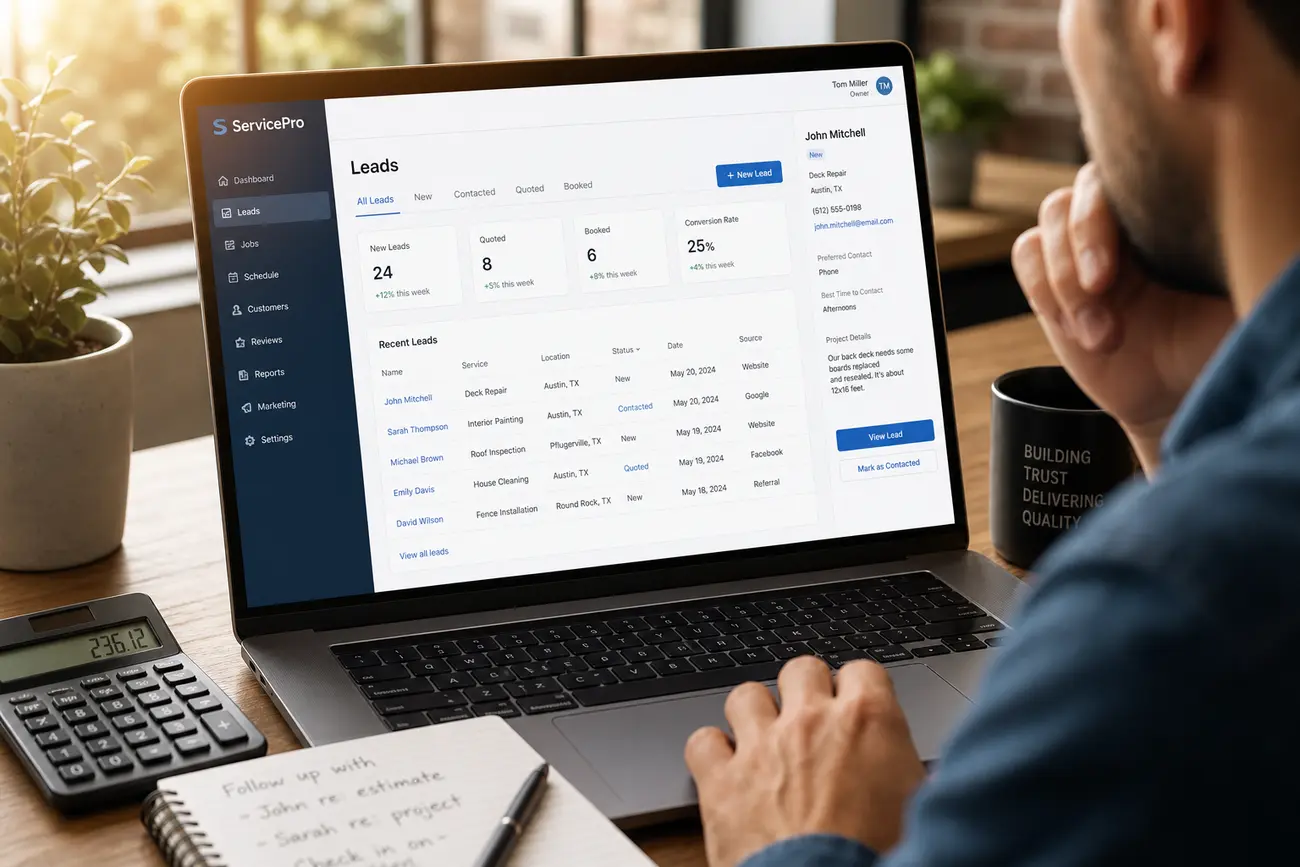
The average landing page conversion rate can tell you whether visitors are taking action, but it cannot tell you whether those actions are creating pipeline. A landing page is not “working” just because it gets form fills; it works when the right visitors become qualified leads, sales-ready conversations, and eventually real opportunities.
What the Average Landing Page Conversion Rate Really Tells You
The average landing page conversion rate is the percentage of visitors who complete the intended action on a page. That action might be submitting a form, booking a demo, downloading a guide, starting a free trial, or requesting a consultation.
As a benchmark, the average landing page conversion rate is useful because it gives you a starting point for comparison. But it is dangerous as the only success metric. Industry, traffic source, offer type, audience awareness, price point, and buying intent can all change what “good” looks like.
A page can beat the average landing page conversion rate and still fail if the leads are students, vendors, poor-fit companies, or people with no buying intent. Treat conversion rate as the first diagnostic signal, not the final verdict.
The Core Lead Generation Metrics That Show Whether Your Landing Page Is Working
To understand performance, track more than total leads. At minimum, your scorecard should include visitors, sessions, form starts, form completions, conversion rate, cost per lead, lead source, device performance, and form abandonment rate.
Form abandonment is especially useful. If many people start but do not complete the form, the issue may be friction: too many fields, unclear privacy expectations, weak perceived value, or a technical problem on mobile.
Separate total leads from qualified leads. Then add sales follow-up metrics such as contact rate, meeting-booked rate, and opportunity creation rate. A practical scorecard compares four things: traffic quality, conversion behavior, lead quality, and sales movement.
How to Measure Lead Quality After the Form Fill
A qualified lead should match your ideal customer profile and show a relevant need. Define qualification using firmographic fit, role, company size, budget, urgency, problem-solution alignment, and whether the person can influence a purchase decision.
Use hidden fields, CRM data, lead scoring, and sales feedback to identify which conversions are worth pursuing. Compare your marketing-qualified lead rate with your raw conversion rate. If the average landing page conversion rate looks strong but the qualified lead rate is weak, the page may be attracting the wrong audience.
Track disqualification reasons such as students, vendors, wrong company size, no budget, irrelevant use case, or unsupported geography. Sometimes a lower conversion rate is healthier because the page pre-qualifies visitors and produces more sales-ready leads.
Benchmarks for a High Converting Landing Page Without Chasing Vanity Metrics
A high converting landing page should be judged against its traffic source and offer type, not a universal number alone. Demo requests and consultations usually require higher intent than webinar registrations, gated guides, or newsletter signups. Free trials can convert well, but quality depends on activation and product fit.
Traffic source matters. Paid search visitors may convert differently from organic search, email, paid social, referrals, or retargeting because each audience arrives with different intent. Your best benchmark is the page’s own historical baseline combined with downstream quality.
Set separate goals for conversion rate, qualified lead rate, and meeting-booked rate. That prevents a common mistake: celebrating a page that beats the average landing page conversion rate while producing leads that never become conversations.
Diagnostic Signals: Where Your Landing Page Is Losing Leads
Use scroll depth, click maps, CTA clicks, form interaction data, and exit rate to see where visitors lose momentum. Review message match between the ad, keyword, email promise, or search intent and the landing page headline. If the promise changes between click and page, conversions usually suffer.
Also audit page speed, mobile usability, above-the-fold clarity, social proof, offer specificity, and form complexity. The problem may be traffic quality, page persuasion, technical friction, or sales follow-up.
Irrelevant search queries are a traffic-quality warning. For example, if a B2B software demo page receives visits from questions like “What is the best free portfolio website maker?”, “What is the free website to put my portfolio on?”, or “What is the best free portfolio?”, those users are likely looking for free portfolio platforms, not your offer. Google does not provide a free “Google portfolio” product in the same sense as a dedicated portfolio builder. Wix does offer a free website builder plan, but it includes limitations such as Wix branding and restricted domain options; paid plans vary by plan and region. A disadvantage of Wix is reduced flexibility compared with fully custom development, and alternatives may include Webflow, Squarespace, WordPress, or specialized portfolio platforms depending on the user’s needs. If those queries are reaching your page, optimize targeting before judging the page itself.
What High Converting Landing Page Examples Have in Common
The best high converting landing page examples should be analyzed by structure, not copied visually. Strong pages share a clear promise, focused CTA, strong proof, low friction, and tight message alignment with the visitor’s source.
A demo page might use role-specific benefits and proof from similar companies. A lead magnet page might promise a tangible outcome, such as a calculator, checklist, or benchmark report. For example, interactive tools can improve lead quality when they reveal intent and business context; see how website calculators generate qualified leads.
The strongest pages do not optimize only for submissions. They pre-qualify visitors through copy, form fields, examples, and proof points so sales receives better-fit conversations. Document winning elements in a reusable testing checklist.
A Practical Reporting Framework for Landing Page Performance
Organize reporting into four layers: traffic quality, page engagement, conversion performance, and revenue movement. A simple funnel view might be: visitors to conversions, conversions to qualified leads, qualified leads to meetings, and meetings to opportunities.
Review basic performance weekly to catch directional issues, such as rising cost per lead, falling form completions, or mobile conversion drops. Use monthly analysis for strategic decisions, including offer changes, audience segmentation, and budget shifts.
Segment reports by campaign, keyword, audience, device, geography, and offer. Most importantly, align marketing and sales on definitions before judging whether the landing page is working. This is where landing page reporting connects to broader pipeline design, such as building a predictable pipeline with revenue architecture.
How to Improve Results Once You Know the Numbers
Prioritize fixes based on the biggest funnel leak. If traffic is low quality, changing the form will not solve the issue. If form abandonment is high, rewriting the headline may not be the fastest win. If meetings are not being booked, sales follow-up speed and lead routing may matter more than page design.
Test one meaningful hypothesis at a time: headline clarity, CTA specificity, proof placement, form length, offer relevance, page speed, or mobile layout. Use qualitative feedback from sales calls, form responses, chat logs, and session recordings to explain the quantitative data.
Do not declare a test winner until it has enough traffic and the lead quality impact is known. Revisit the page regularly because audience intent, competition, campaigns, and offers can change the true baseline for the average landing page conversion rate.
FAQ
What is a good average landing page conversion rate?
A good average landing page conversion rate depends on your industry, traffic source, offer type, and audience intent. Use benchmarks as context, but judge success alongside qualified lead rate, meeting-booked rate, and opportunity creation.
How do I know if my landing page is generating quality leads?
Compare form submissions with your qualification criteria. Look at sales acceptance, contact rate, meeting-booked rate, disqualification reasons, and whether leads become opportunities. Quality is proven after the form fill, not at submission.
What makes a high converting landing page successful?
A high converting landing page usually has strong message match, a clear value proposition, one focused CTA, credible proof, fast loading, mobile usability, and a form that asks only for information needed at that stage.
Should I optimize for more leads or better leads?
Optimize for qualified leads and sales conversations, not raw form-fill volume alone. More leads are only valuable if they match your ideal customer profile and can realistically move through the pipeline.
How often should landing page metrics be reviewed?
Check basic performance weekly for sudden changes in traffic, conversion rate, cost per lead, and technical issues. Review deeper trends, lead quality, sales movement, and test results monthly.
Share Article
Your Digital Edge, Fully Automated
Spin up a cutting-edge website in minutes and preview it free - no signup, no credit card. Then keep growing it with MR.ROBOT's AI pipeline that writes, optimizes, and publishes SEO articles straight from your phone.
No signup. No credit card. You only pay when you love the result.