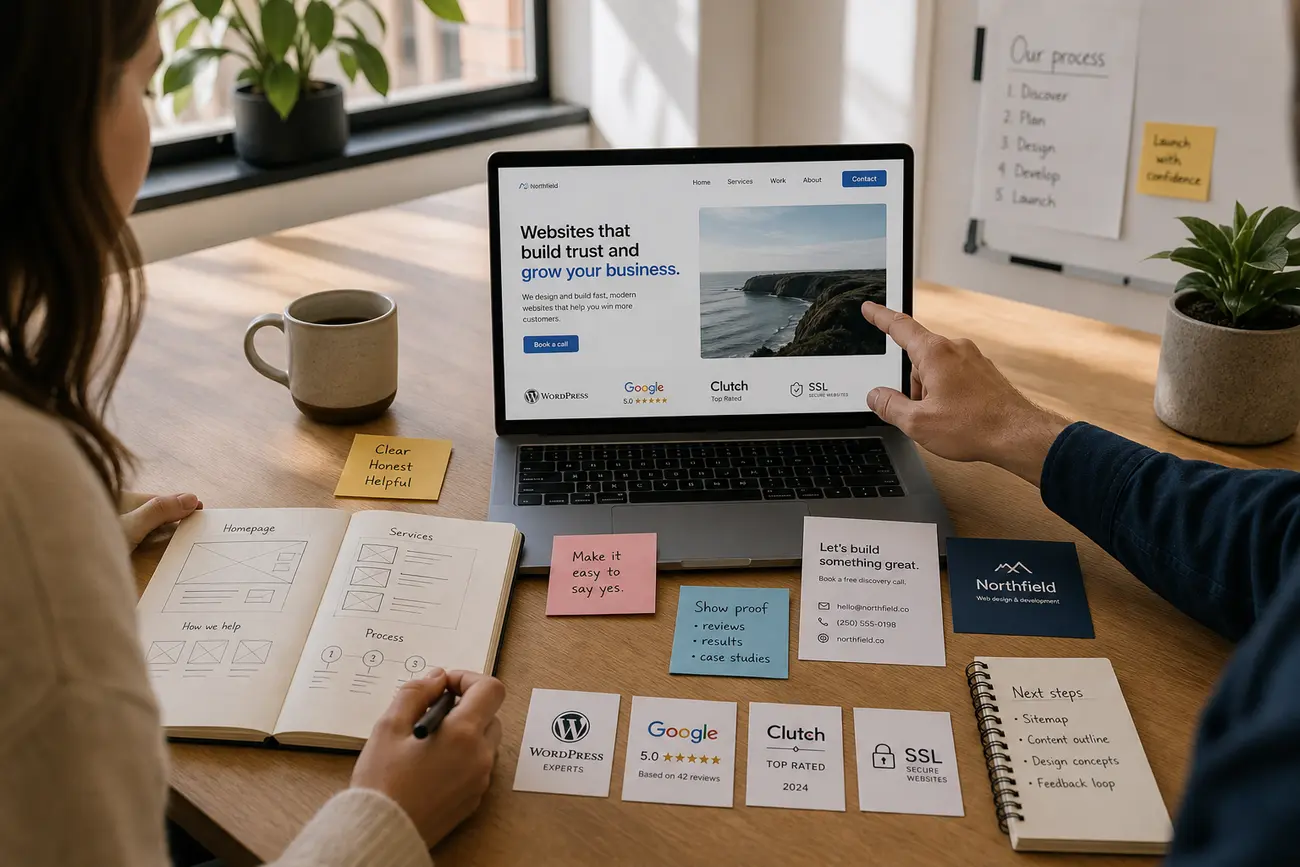
An ad landing page can make or break paid traffic: imagine a local service business paying for clicks on “same-day boiler repair,” only to send visitors to a generic homepage about all plumbing services. This article shows how to match keywords, ads, and landing page messaging so more visitors feel they are in the right place and take the next step.
Why Message Match Is the Fastest Way to Improve an Ad Landing Page
Message match is the consistency between the visitor’s search keyword, your ad copy, the landing page headline, the offer, the proof, and the call to action. When someone clicks an ad, they are not asking to explore your whole website. They are responding to a specific promise: faster service, a free quote, a useful guide, a discount, or a solution to an urgent problem.
If the ad says “Get a Same-Day HVAC Repair Quote” but the page headline says “Welcome to Smith Home Services,” the visitor has to work too hard. That moment of doubt increases bounce rate, lowers conversion rate, and raises cost per lead. Before increasing ad spend, improve the ad landing page so the post-click experience confirms the promise immediately.
Map the Visitor’s Journey From Keyword to Click to Conversion
Start with search intent. A problem-aware visitor searches “why is my AC leaking water.” A solution-aware visitor searches “AC repair near me.” A price-aware visitor searches “AC repair cost.” A ready-to-buy visitor searches “emergency AC repair open now.” These people should not all land on the same generic page because they need different information before converting.
Group keywords by intent, then match each group to a landing page promise. Emergency service keywords need speed, availability, phone visibility, and trust. Comparison keywords need proof, reviews, guarantees, and reasons to choose you. Price-related keywords need expectation-setting, value, and a low-risk next step. This is how landing pages that convert feel relevant without becoming complicated.
Align Ad Copy and Landing Page Messaging Without Sounding Repetitive
The easiest fix is to repeat the core promise from the ad in the landing page headline or subheadline. If the ad promotes “Free Website Audit for Local Service Businesses,” the page should not lead with “Grow Your Brand Online.” It should confirm the same offer, audience, product, location, and urgency.
Message match does not mean copying every word. Use the headline to confirm the click, then use supporting copy to expand the promise. For example: “Book Your Free Website Audit” can be followed by “Find the conversion leaks costing your service business qualified leads.” Avoid bait-and-switch language, such as advertising a free audit but opening with a paid consultation.
Build Landing Pages That Convert With a Clear Offer and CTA
Your offer should be visible above the fold: what the visitor gets, who it is for, and why it matters. A strong ad landing page usually has one primary CTA that matches the visitor’s stage, such as “Book a free consultation,” “Get a quote,” “Call now,” or “Download the guide.” Vague buttons like “Submit” or “Learn More” often weaken intent.
Remove competing navigation, unrelated service links, and secondary actions that distract from the conversion goal. Ask only for the information needed to complete the next step. Add microcopy near the CTA, such as “No obligation,” “Response within one business day,” or “Your details are never shared.” If speed matters to your offer, connect the page to a process for faster lead follow-up.
Use Landing Page Best Practices to Reduce Post-Click Friction
The most important landing page best practices are practical: fast load time, mobile readability, clear visual hierarchy, and a page that makes sense within seconds. Use benefit-led headings, short sections, bullets, and relevant imagery. Keep the design consistent with the ad and brand so the experience feels continuous rather than disconnected.
Place trust signals close to decision points. Reviews, case studies, certifications, guarantees, client logos, before-and-after examples, and privacy reassurance all reduce perceived risk. Also answer the objections that stop prospects from converting: “How much will it cost?” “How quickly can you help?” “Can I trust you?” “What happens after I submit the form?”
Create Campaign-Specific Pages Instead of Sending Traffic to a Generic Website Page
A general website page informs broadly. An ad landing page drives one action from one campaign promise. In this context, a “page” means one unique URL with its own content and purpose. For a paid visitor, the “first page” is the page they reach after clicking the ad, so it must answer the ad promise immediately.
One landing page may be enough when the ads target the same audience, offer, location, and intent. Create separate pages when campaigns target different services, buyer stages, cities, industries, or offers. Sending paid traffic to a homepage is risky when the ad promises a specific solution; the visitor may not search your site to find it. If you are improving your broader site as well, review what a service business website needs to turn visitors into leads.
Measure Message Match and Improve It With Simple Tests
Track conversion rate, bounce rate, scroll depth, form starts, form completions, and cost per conversion by campaign or keyword group. If one ad group gets clicks but few form starts, the landing page promise may not match intent. If many people start but abandon the form, friction may be the problem.
Use heatmaps, session recordings, and form analytics to see where visitors hesitate or drop off; this guide to using heatmaps and session recordings to find conversion leaks is a useful next step. Test one meaningful change at a time: headline wording, offer framing, CTA copy, proof placement, or form length. Document winning ad-to-page combinations so future campaigns begin with proven patterns.
FAQ
What is an ad landing page?
An ad landing page is a dedicated page visitors reach after clicking an ad. It is built around one campaign promise, one audience need, and one primary conversion action.
What is the first thing visitors should see on a landing page?
Visitors should first see a headline that confirms the ad promise, followed by a clear benefit, relevant proof, and a CTA that matches why they clicked.
What counts as one landing page for an ad campaign?
One landing page is usually one unique URL with one main offer, one audience focus, and one primary goal. That answers the common question “What counts as one page?” in campaign measurement.
Should every ad have its own landing page?
Not always. Create separate landing pages when ads target different intents, offers, audiences, locations, or products. Similar ads with the same promise can often share one page.
What makes landing pages that convert perform better?
Landing pages that convert usually have strong message match, a clear offer, low friction, visible trust signals, fast loading, mobile-friendly design, and a CTA aligned with visitor intent.
What landing page best practices matter most for small businesses?
Match the ad promise, keep the page simple, show proof quickly, reduce form friction, make follow-up fast, and test one improvement at a time.
Is SDS-PAGE related to an ad landing page?
No. SDS-PAGE stands for sodium dodecyl sulfate-polyacrylamide gel electrophoresis, a lab technique that separates proteins mainly by size. SDS is the detergent used in the method; it is not the same as SDS-PAGE. Gel electrophoresis is the broader category, while SDS-PAGE is one specific type.
Do you need Page Pilot AI to create landing pages?
No specific tool is required. If you are checking whether Page Pilot has a free version or what Page Pilot AI costs, use the vendor’s current pricing page because plans change. The same message-match principles apply in any landing page builder.
Share Article
Your Digital Edge, Fully Automated
Spin up a cutting-edge website in minutes and preview it free - no signup, no credit card. Then keep growing it with MR.ROBOT's AI pipeline that writes, optimizes, and publishes SEO articles straight from your phone.
No signup. No credit card. You only pay when you love the result.