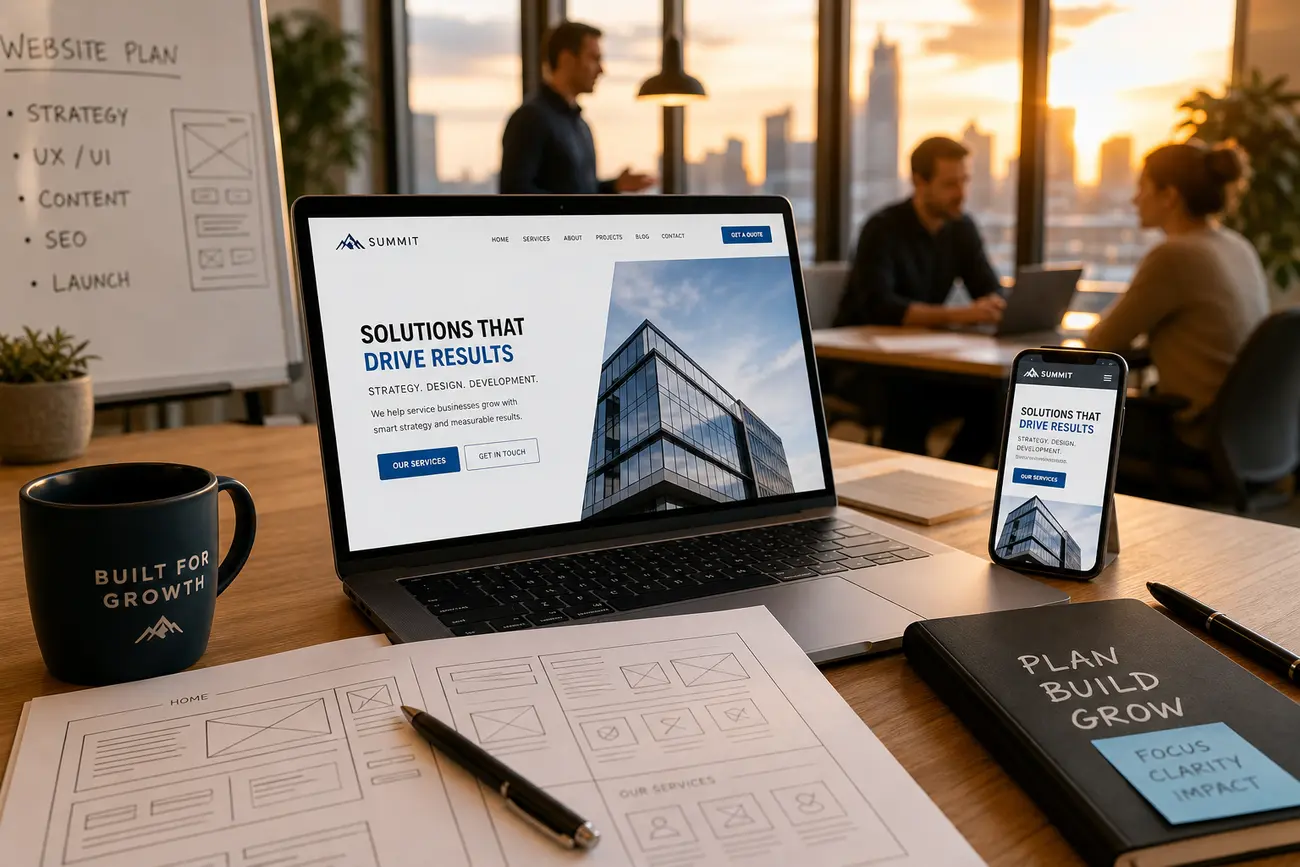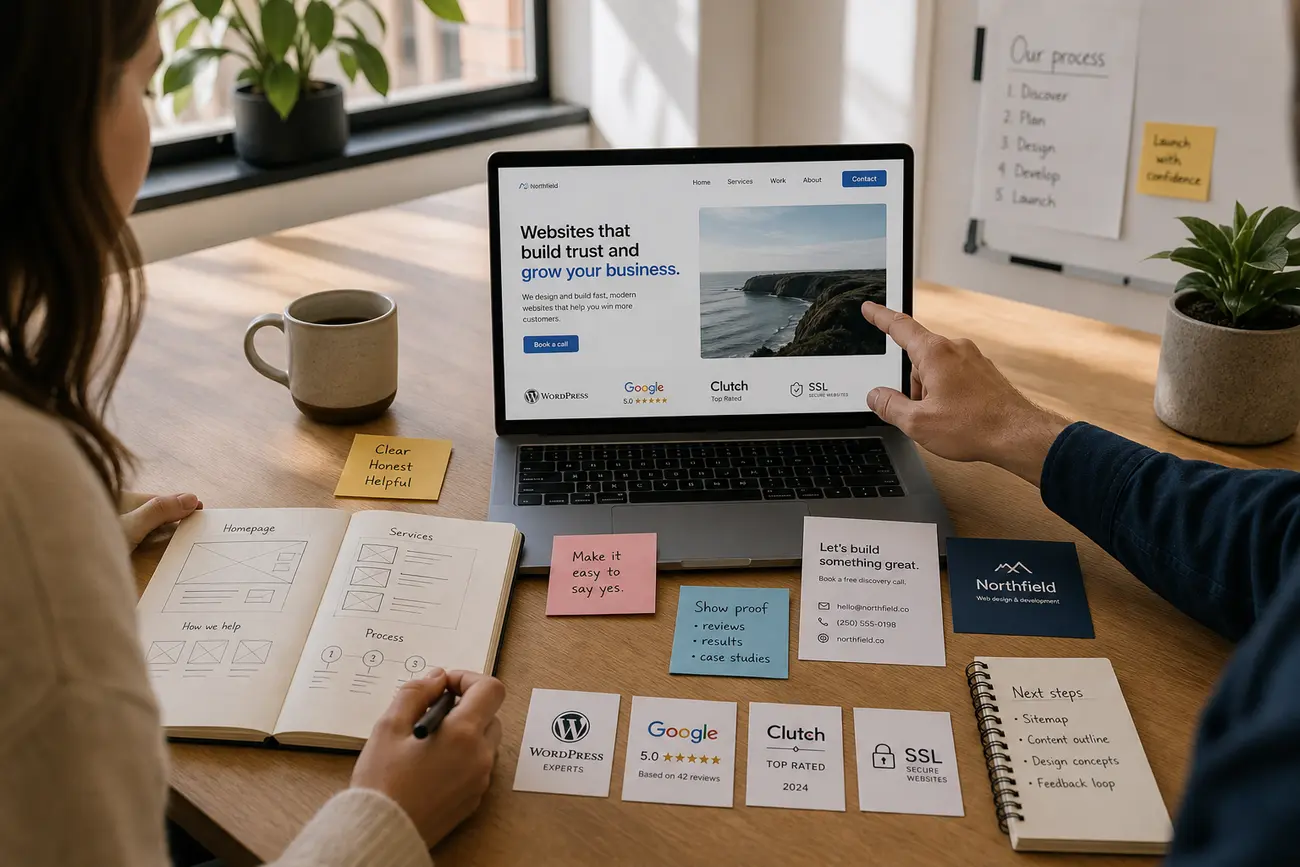
Web design services for small business should do more than make a company look professional; a service business website is a guided sales conversation that quickly proves relevance, builds trust, and makes the next step obvious. If your site does not help visitors understand “Is this for me?”, “Can I trust them?”, and “What should I do now?”, it will leak leads even if it gets traffic.
Why Service Business Websites Must Be Built for Lead Conversion
Traffic alone does not create enquiries. A visitor may arrive from Google, an ad, a referral, or a social post, but they convert only when the page gives them clarity, credibility, and a low-friction way to act. Strong web design services for small business combine messaging, user experience, local proof, and follow-up systems.
For a service business, a qualified lead is usually someone who fits your service area, needs a specific service, has some level of budget readiness, and has a real timeline or urgency. Your website should filter for that fit without making good prospects work too hard.
The Above-the-Fold Section: Make the Offer Clear in Seconds
The top of the page should immediately say who you help, what you do, and what outcome the customer gets. A weak headline like “Quality Solutions for Your Needs” creates doubt. A stronger headline might say, “Emergency Plumbing Repairs for Homeowners in North London” or “Bookkeeping for Growing E-Commerce Businesses.”
Add one short supporting sentence that removes uncertainty: your service area, response time, specialist niche, or main guarantee. Then use one primary call to action, such as “Request a Quote,” “Call Now,” or “Book a Free Consultation.” If needed, add a lower-commitment option like “See Our Work” or “Ask a Question.”
Use imagery that feels real: your team, your work, your result, your clinic, your vehicle, or a customer scenario. Generic stock photography rarely builds trust for local and relationship-driven services.
Core Pages Every Service Business Website Needs
A focused homepage should explain the business, route visitors to key services, show proof, and drive action. Each major offer should also have its own service page so visitors and search engines can understand relevance clearly.
Your About page should prove expertise and humanize the business: who you are, how you work, why customers choose you, and what standards you follow. Your Contact page should include phone, form, email, opening hours, service area, and what happens after someone enquires.
If you serve multiple towns, neighborhoods, or regions, location pages can support local SEO and reassure visitors that you actually work in their area. These pages should be genuinely useful, not duplicated doorway pages.
Trust Signals That Turn Skeptical Visitors Into Enquiries
Trust signals reduce perceived risk. Use reviews, testimonials, ratings, licenses, insurance details, certifications, trade memberships, warranties, and relevant partner badges where they apply. Specific proof is stronger than vague praise: names, locations, photos, project types, and outcomes all help.
Case studies and project snapshots are especially persuasive. A landscaper can show before-and-after photos, a consultant can describe a measurable operational improvement, and a clinic can explain its treatment process and patient experience without making unsupported claims.
Looking at small business website examples across trades, consultants, clinics, agencies, and local services shows the same pattern: the best sites do not hide their proof. They place it near decision points, especially around service explanations and calls to action.
Calls to Action and Forms That Reduce Friction
Place calls to action consistently in the header, hero section, service pages, proof sections, and footer. Match the CTA to intent: “Call Now” for urgent needs, “Request a Quote” for priced work, “Book a Consultation” for advisory services, and “Download a Guide” for longer buying cycles.
Keep enquiry forms short. Ask only for what you need to qualify and respond: name, contact details, service needed, location, and a short message. Add microcopy such as “We respond within one business day” or “Your details are never shared” to reduce anxiety.
On mobile, phone numbers should be tappable and buttons should be easy to see and press. For more detail on improving lead flow, see this guide to building a lead-generating website that converts.
Follow-Up Paths: What Happens After the Visitor Converts
Conversion optimization does not stop after a form submission or phone call. A confirmation page and automated email should set expectations, confirm the request, and reinforce that the visitor made the right choice.
Connect forms to a CRM, inbox, booking tool, or sales pipeline so leads are not lost. Segment enquiries by service type, urgency, and location so the response is relevant. For visitors who are interested but not ready, nurture emails, retargeting, or helpful resources can keep your business top of mind.
DIY Builders vs Small Business Website Design Services
DIY builders can be useful for simple starter sites, especially when budget is limited. Wix, Carrd, Google Sites, and similar tools can help a freelancer, student, photographer, artist, or early-stage idea get online quickly. A free portfolio website can work as a temporary proof-of-work page.
However, professional small business website design services usually add value through strategy, messaging, SEO structure, conversion planning, performance, ownership clarity, and integration with lead systems. Platforms like Wix may be enough for a basic site, but can create limitations around advanced customization, portability, SEO control, performance, or scaling depending on your needs.
A service business should consider professional web design services for small business when the market is competitive, paid ads are running, services are complex, enquiries are weak, or conversion rates are low. The question is not “Does the website look presentable?” but “Does it generate qualified enquiries profitably?”
How to Evaluate Whether Your Website Is Working
Track conversion rate, calls, form submissions, booked consultations, enquiry source, and lead quality. Rankings and traffic matter, but a site that attracts the wrong visitors or fails to convert them is not doing its job.
Use analytics, call tracking, form tracking, and heatmaps to find where visitors drop off. Review service page rankings and local search visibility for your most valuable services. If you want to go deeper, this article explains how to measure lead quality from your campaigns.
Improve the site continuously. Test headlines, CTA wording, form length, trust signals, and page layouts. The best web design services for small business treat the website as a lead-generation asset, not a one-time design project.
FAQ
Is Wix website builder really free?
Yes, Wix has a free plan, but serious business use usually requires a paid plan. A paid plan is typically needed for a custom domain, fewer platform limitations, stronger credibility, and a more professional customer experience.
What is a disadvantage of using Wix for a service business website?
A key disadvantage is that Wix can limit flexibility as the business grows. Depending on the site, you may face constraints around advanced customization, portability, technical SEO control, performance optimization, and more complex conversion or CRM integrations.
Which free website is best for portfolios?
The best free portfolio platform depends on your needs. GitHub Pages is strong for developers, Behance suits designers and creatives, Adobe Portfolio is useful for Creative Cloud users, Wix works for simple visual sites, and Carrd is good for lightweight one-page portfolios.
Is Google portfolio free?
If you mean publishing a simple portfolio with Google tools, Google Sites is free to use with a Google account. It can work for a basic portfolio, but it is limited compared with a custom website built for branding, SEO, and lead generation.
Where can I host or publish my portfolio website for free?
Common free options include GitHub Pages, Netlify, Vercel, Behance, Google Sites, and free website builder plans such as Wix or Carrd. The right choice depends on whether you need design simplicity, developer control, a custom domain, or a quick public profile.
Can a free portfolio website work for a small service business?
It can work as a temporary starting point, especially for a solo provider testing an offer. But most service businesses eventually need stronger trust signals, local SEO, service pages, lead capture, analytics, and follow-up tools to convert visitors consistently.
Do alternative search engines like Dogpile matter for service business websites?
Dogpile still exists as a metasearch engine and web portal that pulls results from multiple sources. It is used for broad web searching, but it is not usually better than Google for local service discovery. Most service businesses should prioritize Google visibility, local SEO, reviews, and conversion-focused pages.
Share Article
Your Digital Edge, Fully Automated
Spin up a cutting-edge website in minutes and preview it free - no signup, no credit card. Then keep growing it with MR.ROBOT's AI pipeline that writes, optimizes, and publishes SEO articles straight from your phone.
No signup. No credit card. You only pay when you love the result.