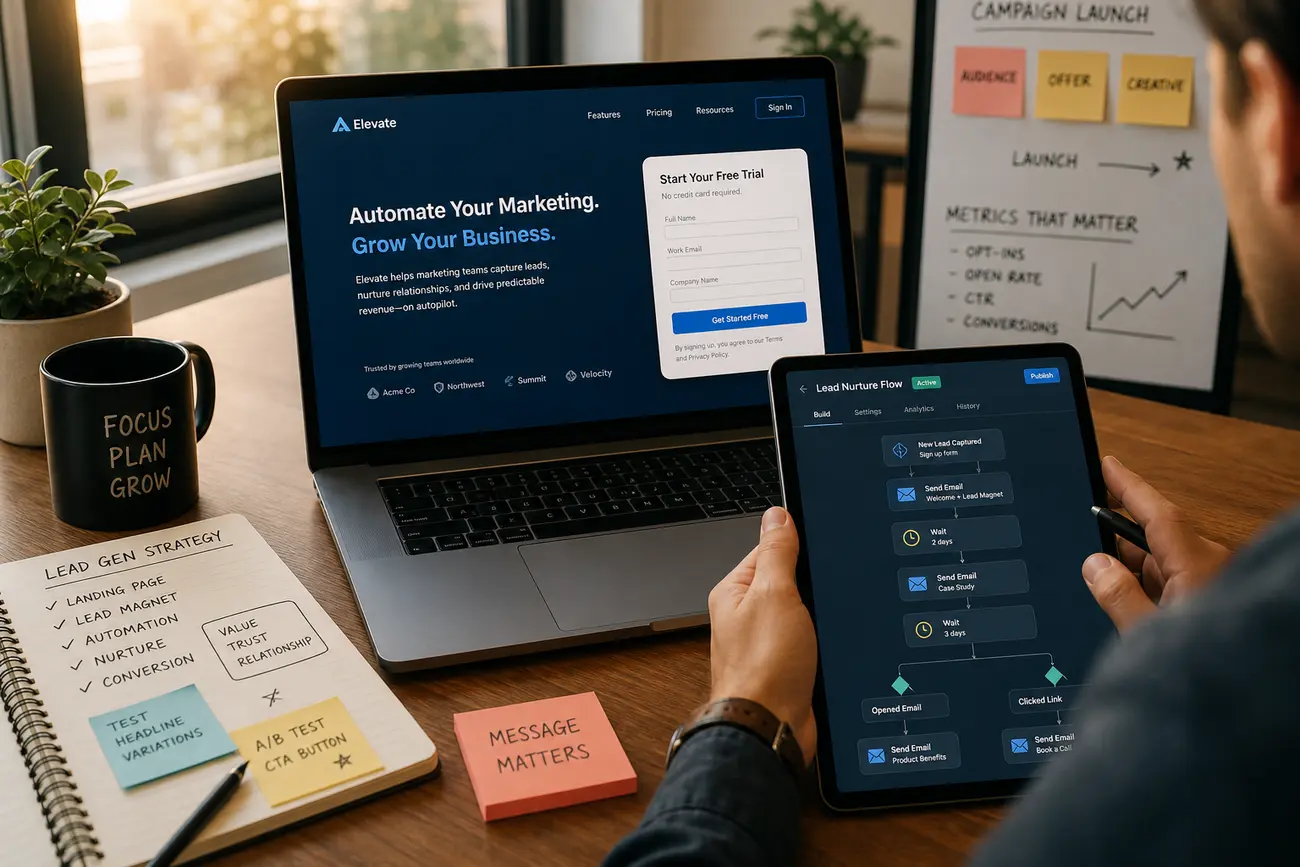
Lead magnet examples are everywhere, but most downloadable freebies do little more than grow a cold email list. A strong lead magnet for a service business does something more valuable: it helps you identify urgent, high-fit prospects before the first sales call, so your team spends less time chasing curiosity and more time speaking with buyers who have a real need.
What Makes a Lead Magnet Attract Qualified Service Business Leads
A lead magnet is a useful, specific resource offered in exchange for contact details and buying-context information. For service businesses, the goal is not simply to collect as many email addresses as possible. The real goal is to attract people who have a problem your service solves, a reason to act, and enough fit to become a serious opportunity.
The best lead magnet examples are narrow. They focus on a service-specific pain point, such as “Is your hiring process leaking qualified candidates?” or “Can your clinic afford another month of missed appointment follow-ups?” This kind of lead magnet design pre-qualifies people because only prospects facing that issue will care enough to engage.
There is also a difference between awareness content and a conversion-focused lead magnet. A blog post can educate broadly, but a lead magnet should feed sales follow-up. It should reveal the prospect’s situation, urgency, and next logical step.
Lead Magnet Examples That Work for Service Businesses
The most effective lead magnet examples for service businesses help prospects evaluate a real decision. They do not just teach; they move the buyer closer to clarity. Good options include a diagnostic checklist that helps someone decide whether they need professional help now, or a pricing guide that attracts budget-aware buyers and filters out poor-fit inquiries early.
- Diagnostic checklist: Best when prospects are unsure whether their problem is serious enough to fix.
- Pricing guide or cost calculator: Useful when budget is a major objection or qualification factor.
- Readiness assessment or scorecard: Captures urgency, gaps, and fit in a structured way.
- Template, script, or worksheet: Gives the prospect one practical win while demonstrating your expertise.
- Mini audit or self-assessment: Creates a natural bridge to a consultation or proposal.
- Before-and-after case study pack: Shows outcomes and clarifies the type of client you serve best.
For example, a commercial cleaning company could offer a “Facility Cleaning Risk Checklist” instead of a generic cleaning guide. A B2B consultant could offer a “Revenue Leakage Scorecard” instead of a broad business growth ebook. The more directly the asset connects to a paid service, the better the lead quality.
Choose the Right Problem Before You Create the Asset
Start with the service you want to sell, then work backward to the question prospects ask immediately before they buy. A cybersecurity firm might hear, “Are we compliant enough for this client contract?” A legal service might hear, “Is this agreement exposing us to risk?” A marketing agency might hear, “Are our ads failing because of targeting, landing pages, or follow-up?”
Use sales calls, support emails, proposal objections, and client onboarding notes to find recurring friction points. Prioritize problems with commercial intent: pricing, risk, compliance, implementation, time savings, missed revenue, or operational bottlenecks. These topics attract people with a business reason to act, not just a casual interest.
Avoid broad topics like “10 marketing tips” or “how to improve productivity.” They may get downloads, but they rarely reveal buying intent. Match each lead magnet to one buyer stage: problem-aware, solution-aware, or vendor-comparison. If you need help mapping the asset into a complete qualification journey, see this guide on how to build a lead generation funnel that qualifies leads.
Lead Magnet Design: Build in Qualification From the Start
Strong lead magnet design starts with the title. A good title names the audience, the problem, and the outcome: “The 12-Point Checklist for Law Firms Losing Leads After Hours” is stronger than “Lead Follow-Up Guide.” Formats such as checklist, calculator, roadmap, audit guide, scorecard, and worksheet work well because they feel practical and fast to use.
Add two to four qualifying fields to the form. Good fields include company size, service need, timeline, budget range, location, current provider, or biggest challenge. Do not turn the form into an interrogation, but do collect enough information to segment follow-up. A prospect who needs help this month should not receive the same response as someone researching for next year.
Keep the asset short enough to consume quickly but valuable enough to justify the opt-in. Inside the content, include decision prompts such as “If you answered yes to three or more of these, it may be time to request an audit.” End with one clear next step: book a consult, request an estimate, submit details for a deeper assessment, or view a relevant service page.
Set Up the Landing Page and Lead Generation Tools
Your landing page should have one promise, one audience, one form, and one call to action. The headline should repeat the concrete outcome, the body copy should explain who it is for, and the form should make the exchange feel worthwhile. Add proof elements such as testimonials, short case results, credentials, client logos if permitted, or service-specific experience.
The right lead generation tools connect the asset to follow-up. At minimum, use a CRM form, email automation, analytics, and calendar booking. Depending on your sales process, you may also use retargeting pixels, call tracking, lead scoring, chat, or routing rules. If paid ads are involved, connect ad platforms and your CRM so you can optimize for qualified opportunities, not just cheap form fills.
Track source, conversion rate, form completion rate, booked calls, sales-qualified leads, proposal rate, and revenue influenced. Downloads alone are not enough. For a deeper measurement framework, read this article on how to measure lead quality from marketing campaigns.
Follow Up With a Measurable Nurture System
Send the asset immediately and use the delivery email to reinforce value. Do not simply say, “Here is your download.” Explain what to look for, how to interpret the result, and what the next best action is if the prospect recognizes a serious gap.
Then create a short email sequence that educates, handles objections, and points toward a consultation or quote request. For example, email one delivers the asset, email two explains common mistakes, email three shares a case example, and email four invites the prospect to book a call. Use lead scoring to flag high-intent actions such as clicking pricing content, visiting service pages, replying to an email, or booking time.
Route qualified leads to sales quickly while placing lower-intent leads into longer-term nurture. Review performance every month and improve the offer, form questions, landing page, and follow-up sequence based on real conversion data. The best lead magnet examples are rarely perfect on the first version; they improve through testing.
Common Mistakes That Make Lead Magnets Generate Poor Leads
The biggest mistake is choosing a topic that is interesting but disconnected from a paid service. A leadership coach offering a generic productivity ebook may attract many readers, but a “Founder Delegation Readiness Scorecard” is more likely to attract people who need coaching, advisory, or operational support.
Another mistake is asking for too little information. A name and email may reduce friction, but it gives sales no qualification insight. On the other hand, a long form can hurt conversions. The balance is to ask only for information that changes how you follow up.
Service businesses also weaken results by creating a long ebook when a checklist, calculator, or worksheet would be more useful; failing to include a clear next step; measuring success by subscriber count instead of qualified calls and revenue; or copying generic lead magnet examples without adapting them to their niche, buyer stage, and sales process.
FAQ
What are the five fundamentals of marketing?
The five fundamentals of marketing are audience, problem, offer, message, and channel. For a lead magnet, that means you must know who you want to attract, what urgent problem they have, what service you eventually want to sell, what promise will make them act, and where they are most likely to find the asset.
What is the 3-3-3 rule in marketing?
The 3-3-3 rule is a simple clarity test: within a few seconds, a prospect should understand who the offer is for, what problem it solves, and what to do next. Applied to lead magnets, the landing page should make the value obvious immediately, without vague headlines or competing calls to action.
What are the 7 basic marketing concepts?
The seven basic marketing concepts are often framed as product, price, place, promotion, people, process, and positioning. In lead generation, these shape what you offer, how pricing expectations are handled, where the lead magnet is promoted, who follows up, how leads move through the system, and why your service is the right fit.
What are the 7 principles of marketing?
The 7 principles of marketing are practical decision areas that help you align audience, offer, value, delivery, communication, proof, and follow-up. For a service business, they ensure your lead magnet promise is relevant, your targeting is precise, your asset is easy to use, and your nurture system turns interest into qualified conversations.
What is the best lead magnet for a service business?
The best lead magnet for a service business is usually one that reveals buyer intent and creates a natural next step. Checklists, calculators, scorecards, readiness assessments, and mini audits often outperform generic ebooks because they help prospects diagnose a real issue and make it easy to request expert help.
How do you know if a lead magnet is working?
A lead magnet is working when it produces qualified business opportunities, not just downloads. Measure form completions, conversion rate, booked calls, sales-qualified leads, proposal rate, close rate, and revenue influenced. If many people download but few are qualified, improve the topic, form questions, landing page, or follow-up sequence.
Share Article
Your Digital Edge, Fully Automated
Spin up a cutting-edge website in minutes and preview it free - no signup, no credit card. Then keep growing it with MR.ROBOT's AI pipeline that writes, optimizes, and publishes SEO articles straight from your phone.
No signup. No credit card. You only pay when you love the result.