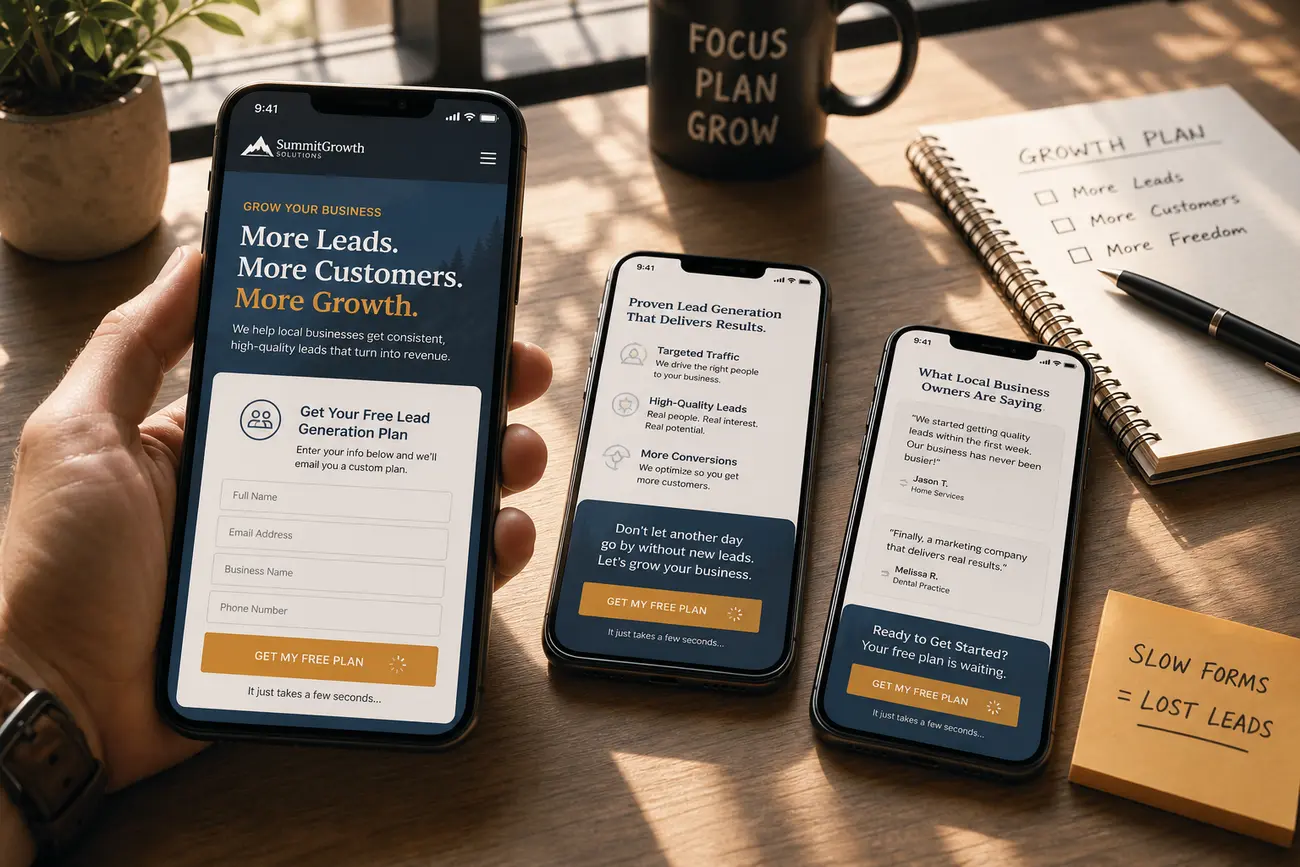
Landing page examples are most valuable when they show how to match the page to the visitor’s reason for arriving. Most small businesses do not need more traffic first; they need searchers, ad clickers, subscribers, social visitors, and referrals to see a page that speaks directly to their intent, objections, and next step.
Why personalized landing pages convert better than one-size-fits-all pages
Visitors from Google Search, paid ads, email, social media, referral partners, and direct traffic are not in the same mindset. A search visitor may be comparing options, an ad visitor expects the exact promise they clicked, an email subscriber remembers a campaign, and a referral visitor arrives with borrowed trust. If all of them land on the same generic page, the message is usually too broad to persuade anyone well.
Personalization increases relevance by adjusting the headline, offer, CTA, proof, and next step to match context. These landing page examples do not require rebuilding your website or buying enterprise software. In many cases, simple rule-based page variants, UTM parameters, and targeted content blocks are enough to create a better match between source, message, and conversion goal.
The five elements to personalize first: headline, offer, CTA, proof, and path
Start with the hero headline. It should reflect the visitor’s source, pain point, or awareness stage. Someone searching “emergency HVAC repair near me” needs immediate availability and location proof; someone downloading a comparison guide needs clarity and education.
- Offer: Match the ask to the intent: demo, quote, checklist, coupon, consultation, webinar, or comparison guide.
- CTA: Use softer CTAs for cold visitors and sales-focused CTAs for high-intent visitors. For deeper guidance, see How to Write Calls to Action That Convert Visitors Into Leads.
- Proof: Show industry testimonials, local reviews, client logos, case studies, or star ratings that match the audience.
- Path: Personalization should continue after conversion through the thank-you page, booking flow, nurture email, or sales routing.
Landing page examples by traffic source
For Google Search visitors, the page should mirror the query intent above the fold. A page for “commercial cleaning quote in Austin” should mention commercial cleaning, Austin, fast quoting, service areas, insurance, and reviews before asking for the lead.
For paid ad visitors, repeat the ad promise, remove navigation distractions, and present one clear offer. If the ad says “Get a free roof inspection,” the landing page should not lead with company history; it should confirm the inspection, explain what is included, and make scheduling easy.
- Social media: Use fast context-setting, visual proof, and a lower-friction CTA such as “See pricing examples” or “Get the checklist.”
- Email: Continue the campaign message with subscriber-specific language, such as “As promised, here is the webinar replay.”
- Referral partners: Acknowledge the partner and borrow credibility: “Recommended by ABC Accounting for growing retailers.”
- Direct or returning visitors: Highlight progress, recent offers, saved resources, or a stronger conversion step such as booking a consultation.
How to segment visitors without overcomplicating your setup
Begin with source and campaign data: UTM source, medium, campaign, ad group, and keyword. Then add signals most SMBs can access easily, such as new versus returning visitors, geography, device type, industry selection, and previous page behavior. Three to five meaningful segments are usually better than dozens of tiny audiences you cannot maintain.
Create a simple table with four columns: segment, intent, main objection, and best CTA. Also document the proof each segment needs. Use privacy-aware data only, avoid creepy references, and never imply you know more about the visitor than they knowingly shared.
One practical warning: keyword tools sometimes surface unrelated People Also Ask questions. Do not force them onto a sales page unless they match the offer. For example: Thingiverse is still online as a 3D model sharing site; it is generally usable, but users should review files, comments, and licenses before downloading; to get things from Thingiverse, search a model, open it, download the files, and prepare them in a slicer; alternatives include Printables, MakerWorld, MyMiniFactory, Cults, and Thangs. Dogpile is still around as a metasearch engine; “Dogpile” is the search engine spelling; you do not “win” the search engine, though a game with that name would have its own rules; “cool” is not a standard Dogpile search requirement. Good Google alternatives include Bing, DuckDuckGo, Brave Search, Ecosia, Startpage, Yahoo, and Dogpile. To set Startpage in a browser, open search or homepage settings and choose or add https://www.startpage.com.
What the best landing pages do differently when they personalize
The best landing pages maintain message match from source to headline, body copy, offer, and CTA. They use one primary action, concise benefit copy, and proof near the point of decision. They also remove irrelevant sections for each audience segment, which reduces cognitive load and keeps the visitor focused.
Conversion fundamentals still matter: fast load time, strong mobile layout, readable forms, accessible contrast, and only the fields needed for the next step. Personalized proof is especially powerful; if you want to strengthen that section, read How to Use Social Proof to Increase Website Conversions.
Where to find landing page inspiration and adapt it to your business
Use landing page inspiration as a research tool, not a copying exercise. Review competitor pages, ad libraries, SaaS galleries, ecommerce funnels, local service pages, and industry case studies. Look for why the page works: the traffic source, offer clarity, CTA strength, proof quality, objection handling, and mobile experience.
Build a swipe file organized by traffic source and audience segment. Save examples of headlines, forms, proof blocks, comparison sections, and thank-you flows. Then translate big-brand ideas into realistic SMB experiments, such as a new testimonial block for referral traffic or a shorter quote form for paid search visitors.
A simple testing plan to improve conversions from existing traffic
Choose one high-traffic or high-cost landing page and one priority traffic source. Record your baseline: conversion rate, lead quality, cost per lead, bounce rate, scroll depth, form completion rate, and downstream sales outcomes. Without a baseline, you cannot tell whether personalization improved results or simply changed the page.
Test one major element at a time: headline, offer, CTA, proof block, or form length. Use A/B testing when traffic is high enough to compare versions reliably. For lower-traffic SMB sites, use directional before-and-after tests, but run them long enough to avoid reacting to a single unusual week.
A simple 30-day rollout works well: audit traffic in week one, choose three segments in week two, create page variants in week three, and launch with measurement in week four. Keep the winning lessons and repeat.
FAQ
What are the easiest landing page elements to personalize first?
Start with the headline, offer, CTA, proof block, and follow-up path. These changes usually create the clearest lift without requiring a full redesign.
Do small businesses need expensive software for website personalization?
No. Many effective changes can be handled with UTMs, simple page variants, forms, email automation, and basic website rules.
How many personalized landing page versions should I create?
Begin with three to five versions based on your most important traffic sources or audience segments. Add more only after you can measure and maintain them.
What traffic sources should have different landing page experiences?
Prioritize paid search, organic search, social media, email, referral partners, and returning visitors because each source usually has different intent.
How do I know whether my personalized landing pages are working?
Measure conversion rate, lead quality, cost per lead, engagement, form completion rate, and downstream sales outcomes such as booked calls or closed deals.
Share Article
Your Digital Edge, Fully Automated
Spin up a cutting-edge website in minutes and preview it free - no signup, no credit card. Then keep growing it with MR.ROBOT's AI pipeline that writes, optimizes, and publishes SEO articles straight from your phone.
No signup. No credit card. You only pay when you love the result.