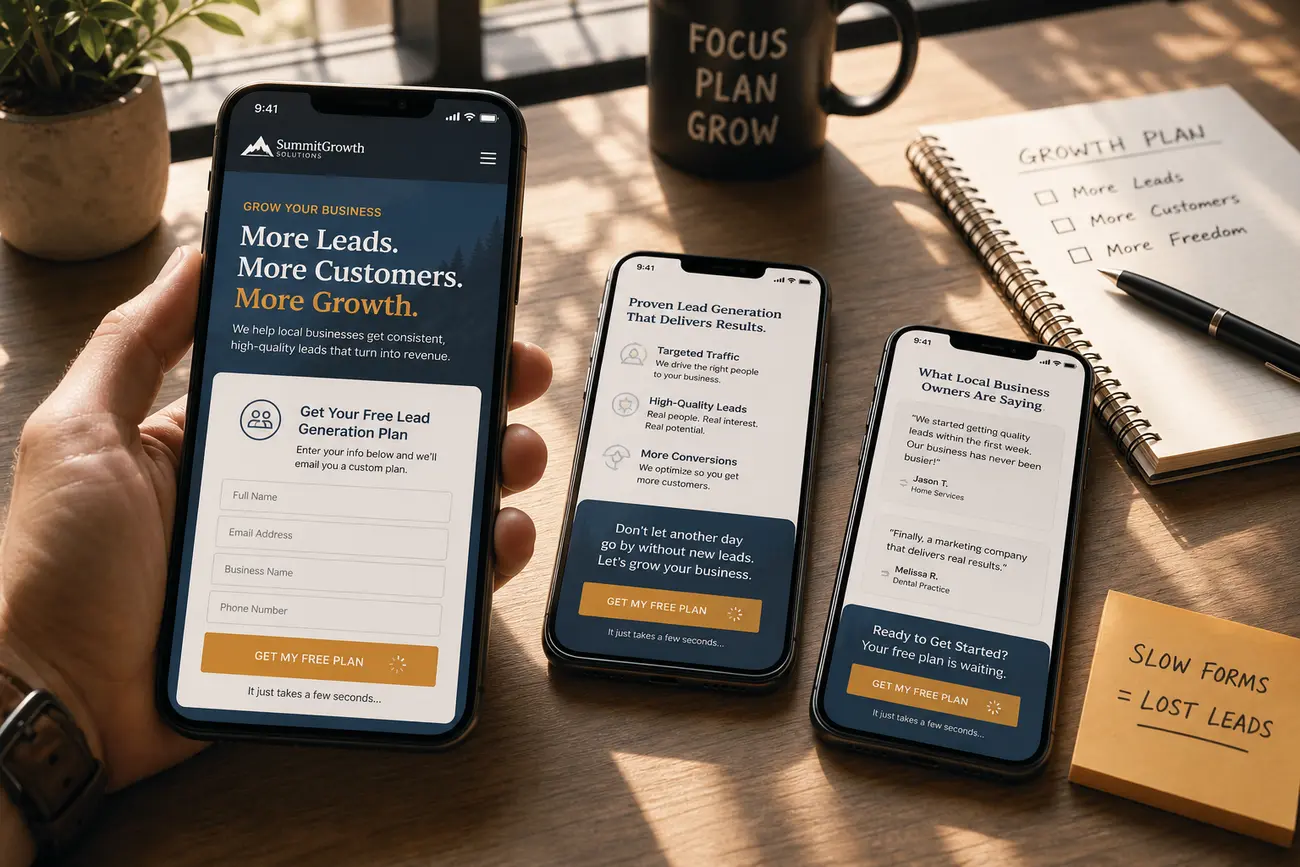
Brand messaging is often the conversion problem hiding in plain sight: visitors arrive, scan your page, and leave because they do not quickly understand what you offer, why it matters, or why they should enquire now. This article shows you how to clarify your message, improve conversion copywriting, and turn more of your existing traffic into qualified leads before you spend more on ads, SEO, or a redesign.
Why clearer brand messaging improves conversions before more traffic or a redesign
Conversions depend on how quickly a visitor can answer four questions: who is this for, what problem does it solve, why should I trust it, and what should I do next? If those answers are vague, even a beautiful website can underperform. Clear brand messaging reduces mental effort, helps the right people recognize themselves, and makes the value of your offer easier to act on.
Many teams try to fix low enquiries with new layouts, more ads, extra SEO content, or a homepage refresh. Those can help, but they are not the highest-leverage first step if the core message is unclear. Increasing traffic only sends more people into the same confusion. A stronger messaging strategy improves service pages, landing pages, demo requests, lead forms, and sales calls because the visitor arrives with better expectations and fewer doubts.
Diagnose the messaging gaps that stop visitors from enquiring
Start by reviewing the homepage, service pages, landing pages, and contact journey as if you were a first-time buyer. Look for vague headlines, generic claims, missing proof, weak calls to action, and pages that explain what the company does internally rather than what the customer gets externally.
A useful page should quickly answer: what is this, is it for me, why should I trust it, and what happens next? Poor conversion copywriting often shows up as internal jargon, feature-heavy copy, unsupported promises, unclear pricing expectations, or process details that are only explained after someone submits a form.
Use evidence, not opinions. Review sales calls, enquiry forms, live chat transcripts, customer interviews, search queries, and session recordings. Repeated objections are messaging clues. If prospects keep asking about timelines, deliverables, cost, implementation, or proof, those answers should be visible before the enquiry.
Build a messaging strategy around the customer’s buying decision
A strong messaging strategy starts with the buying decision, not the company brochure. Define each audience segment by pain point, buying trigger, desired outcome, objections, decision criteria, and fit for the offer. This is also how you define your target audience: group people by the problem they are trying to solve and the conditions that make them ready to buy.
Map the customer’s awareness stage. A problem-aware visitor needs language that names the pain and cost of inaction. A solution-aware visitor needs comparison, proof, and differentiation. A provider-aware visitor needs reassurance that you are credible, relevant, and easy to work with. A ready-to-enquire visitor needs a clear next step.
At the moment of conversion, prioritize relevance, differentiation, proof, risk reduction, and action. Your brand messaging should guide the page structure, headline hierarchy, proof points, and calls to action before visual design decisions. Design can amplify clarity, but it cannot rescue a message that does not say enough.
Use a brand messaging framework to make the offer instantly clear
A practical brand messaging framework turns scattered ideas into a repeatable structure. Start with a positioning statement: for who, facing what problem, we provide what offer, so they can achieve what outcome, unlike what alternative.
Then translate that into page copy. Your primary headline should communicate the main value proposition in plain English, not a slogan. The subheading should explain who the offer is for and what result the visitor can expect. Underneath, build message pillars around the problem, promise, process, proof, differentiation, objection handling, and call to action.
The same brand messaging framework can be adapted across the homepage, service pages, paid landing pages, sales decks, and proposal templates. The words do not need to be identical everywhere, but the underlying promise, audience fit, and proof should feel consistent.
Rewrite headlines, proof points, and calls to action for conversion
Turn vague headlines into specific statements of value. “Marketing solutions for growing businesses” is easy to ignore. “SEO and conversion copywriting for B2B service firms that need more qualified enquiries” tells the right visitor what the page is about and why it may matter.
Replace generic benefits with proof. Use case studies, testimonials, client logos, certifications, before-and-after examples, process evidence, and relevant metrics where you can support them. If you want deeper guidance, see this article on how to use social proof to increase website conversions.
Make calls to action specific and aligned with intent. Instead of “Submit,” use “Request a consultation,” “Book a strategy call,” or “Get a quote.” Add microcopy near forms and buttons to reduce anxiety around response time, privacy, sales pressure, and what happens after submission. For more examples, read how to write calls to action that convert visitors into leads.
Handle objections before they become reasons to leave
Visitors rarely leave only because they are uninterested. They often leave because an unanswered concern feels like risk. Common objections include cost, timing, complexity, trust, internal approval, switching providers, and uncertainty about results. Strong brand messaging answers these concerns before they block the enquiry.
Do not hide every hard question in an FAQ or save it for the sales call. Explain who the offer is and is not right for. Clarify deliverables, timelines, process stages, required involvement, and what a realistic outcome looks like. Comparison copy can help buyers understand trade-offs without feeling pressured.
Be reassuring without overpromising. This is especially important for marketing, SEO, advertising, and conversion optimization services, where results depend on the offer, market, competition, traffic quality, sales process, and execution. Credible copy creates confidence by being specific and honest.
Test and refine your conversion copy without guessing
Measure messaging changes by enquiry rate, qualified lead rate, form completion rate, demo bookings, sales call quality, and revenue contribution. If you have enough traffic, use A/B testing. If not, compare before-and-after performance and collect qualitative feedback from sales conversations and customer interviews.
Review heatmaps, scroll depth, session recordings, and form analytics to find hesitation points. If visitors stop before proof, the page may be asking for trust too early. If they reach the form but do not submit, the next step may feel unclear, too demanding, or too risky.
Update your messaging strategy as the audience, offer, market category, and competitive landscape change. The most successful marketing strategies combine clear positioning, persuasive copy, strong offers, trust-building, targeted traffic, follow-up, and continuous optimization.
FAQ
How do you define your target audience for better brand messaging?
Define your target audience by shared problem, buying trigger, desired outcome, decision criteria, objections, and fit for the offer. Demographics can help, but conversion copy improves most when you understand what the buyer is trying to solve and what would make them confident enough to act.
What are the 5 steps of a marketing approach for improving conversions?
The five steps are: research the audience, clarify positioning, write the message, publish and promote the page, then measure and refine performance. This keeps the work focused on the customer’s decision instead of isolated design or traffic tactics.
What are the most successful marketing strategies for service businesses?
The most successful marketing strategies for service businesses combine sharp positioning, clear conversion copy, strong proof, targeted traffic, and consistent follow-up. No single tactic works well if the offer is unclear or the sales process fails to reinforce the website message.
What does SEO services mean, and how does it relate to conversion copywriting?
SEO services help a website attract organic traffic from search engines through content, technical improvements, authority building, and search-intent optimization. Conversion copywriting helps that traffic understand the offer, trust the business, and take the next step.
Do I need an SEO agency if my website is not converting?
You may need an SEO agency if you lack qualified organic traffic, but first check whether your current pages clearly explain the offer, audience fit, proof, process, and next step. More traffic will not solve a brand messaging problem on its own.
How to rank 1 in SEO?
To rank number 1 in SEO, satisfy search intent better than competing pages, publish genuinely useful content, maintain strong technical performance, build authority and relevant links, and provide a good user experience. Rankings are earned over time, not guaranteed by one tactic.
Who are the best SEO companies?
The best SEO companies are those with relevant case studies, transparent methods, realistic expectations, clear reporting, and experience in your market. Avoid providers that guarantee specific rankings without understanding your site, competition, or commercial goals.
What are the four main product market strategies?
The four main product market strategies are market penetration, market development, product development, and diversification. Each requires different brand messaging because the audience’s awareness, risk level, and reasons to buy are different.
What are five types of advertisements?
Five common types of advertisements are search ads, social media ads, display ads, video ads, and print or out-of-home ads. Whichever channel you use, the message still needs a clear offer, relevant proof, and a specific next step.
What are examples of commercial products?
Examples of commercial products include software subscriptions, consulting packages, professional services, training programs, consumer goods, industrial equipment, and financial products. Each product needs messaging that explains the buyer’s problem, the outcome, the evidence, and the reason to choose it now.
Share Article
Your Digital Edge, Fully Automated
Spin up a cutting-edge website in minutes and preview it free - no signup, no credit card. Then keep growing it with MR.ROBOT's AI pipeline that writes, optimizes, and publishes SEO articles straight from your phone.
No signup. No credit card. You only pay when you love the result.