Conversion rate optimization is not a bag of button-color tricks. It is the process of increasing the percentage of visitors who take a valuable action, then proving which changes caused the lift. Use this playbook to rank opportunities across the conversion funnel, fix the largest revenue leak first, and protect your sales conversion rate from guesswork.
Build your conversion rate optimization framework before changing pages
Before you rewrite a page, define what “conversion” means at each stage. A purchase, subscription, quote request, demo booking, add-to-cart, email signup, and pricing-page view can all matter, but they do not carry the same value.
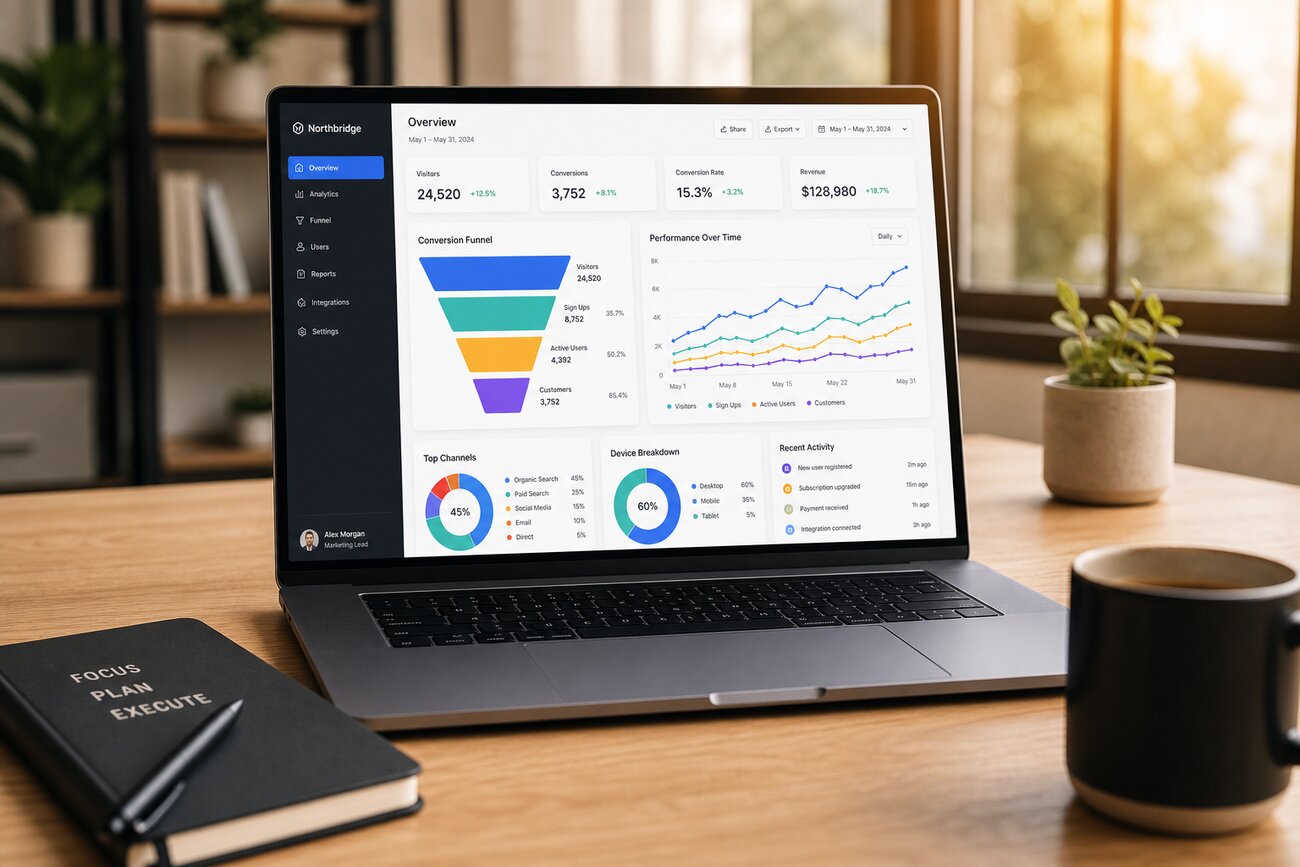
Tactic 1: Map the conversion funnel end-to-end. Write down every step from first visit to revenue. For ecommerce, that may be product page, cart, checkout, payment, and confirmation. For B2B, it may be ad click, landing page, form fill, sales call, proposal, and closed deal. Your conversion funnel map should show the action, owner, traffic source, and measurable drop-off at each step.
Tactic 2: Segment conversion data before you diagnose. A blended conversion rate hides the problem. Break results down by device, channel, campaign, landing page, geography, new versus returning users, and customer type. If mobile paid traffic has a weak sales conversion rate but desktop organic traffic performs well, the fix is probably not a new homepage headline.
The rule is simple: find the biggest revenue leak first. Random best practices create busywork. A strong conversion rate optimization framework points your team toward the page, audience, or step where improvement has the highest financial upside.
Benchmark your sales conversion rate: is a 38% conversion rate good?
A 38% conversion rate can be excellent, average, or misleading. It depends on what is being measured and where the traffic came from. A 38% email-to-webinar registration rate from warm subscribers is very different from a 38% purchase rate from cold paid social traffic.
Tactic 3: Benchmark against yourself first. Compare your current sales conversion rate with the previous month, quarter, campaign, and season. Then compare against industry averages. Your own history tells you whether performance is improving; industry data only gives context.
Separate macro-conversions from micro-conversions. Macro-conversions are revenue actions such as purchases, subscriptions, or signed contracts. Micro-conversions are intent signals such as add-to-cart, pricing-page views, demo bookings, trial starts, or email captures.
If add-to-cart is rising but purchases are flat, your conversion funnel likely has checkout friction. If demo bookings are strong but closed deals are weak, your sales conversion rate problem may sit after the website handoff. Benchmark each step, not just the final number.
Remove friction from the highest-intent steps of the conversion funnel
The fastest wins often sit near the bottom of the conversion funnel, where visitors already want the outcome but something makes them hesitate.
Tactic 4: Audit checkout flows and forms. Remove unnecessary fields, reduce optional decisions, expose total costs early, fix slow-loading pages, and test guest checkout. Every extra field asks the visitor to spend attention. Every surprise shipping fee or hidden setup cost gives them a reason to abandon.
Amazon’s 1-Click ordering is the classic example because it removed repeated effort from a high-intent action. The lesson is not “copy Amazon.” The lesson is to reduce the distance between decision and completion.
Tactic 5: Add trust signals where anxiety peaks. Place reviews, security badges, return policies, guarantees, payment logos, customer counts, and support options near the moment of risk. A trust badge buried in the footer will not help a buyer who is worried on the payment step.
Look for anxiety in behavior data. Repeated form errors, checkout exits, pricing-page pogo-sticking, and support-chat spikes all show where the conversion funnel needs reassurance. Fixing those moments can raise the sales conversion rate without increasing traffic.
Strengthen the offer, message match, and proof on key pages
Many pages fail because the visitor expected one thing and landed on another. The page may look polished, but the promise, proof, and call to action do not line up.
Tactic 6: Align ad copy, landing page, and CTA. If your ad promises “same-day payroll setup,” the landing page headline should repeat that benefit, the body should prove it, and the CTA should match the next step. Message continuity reduces cognitive load and improves conversion rate optimization because visitors feel they are in the right place.
Tactic 7: Make the offer easier to evaluate. Show pricing clearly when price is a key decision factor. Use comparison tables when buyers are choosing between plans. Add guarantees when risk is the blocker. Explain implementation, cancellation, delivery, or onboarding when uncertainty slows action.
Booking.com is strong at this. Its pages combine reviews, scarcity cues, map and location reassurance, cancellation details, and room comparisons near the booking decision. Whether every cue fits your brand is a separate question; the practical lesson is that proof belongs where the decision is being made.
For your own pages, ask: “What must the visitor believe before they click?” Then add the proof that answers that belief gap. Better proof usually beats louder copy.
Run experiments with a prioritization system, not a testing wish list
A testing backlog can become a parking lot for opinions. Prioritization turns conversion rate optimization into a repeatable operating system.
Tactic 8: Score tests with ICE or PIE. ICE scores ideas by Impact, Confidence, and Ease. PIE scores by Potential, Importance, and Ease. Use whichever your team understands faster. A checkout fix affecting 40% of revenue with clear evidence should outrank a homepage animation test with no data behind it.
Tactic 9: Test one hypothesis at a time. “Change the headline, hero image, form length, and CTA color” may produce a lift, but it will not teach you why. A better hypothesis is: “If we replace feature-led copy with outcome-led copy on the demo page, more paid-search visitors will submit the form because the value is clearer.”
The Obama 2008 campaign’s landing-page experiments are a useful model. The team tested combinations of media and calls to action, then used the winning variants to capture more signups and donations. The important takeaway is discipline: clear variants, measurable outcomes, and decisions based on results.
Protect test quality. Run experiments long enough to cover normal traffic patterns, avoid stopping as soon as numbers look exciting, and measure the impact on the right sales conversion rate, not just clicks.
Use conversion rate optimization tools to find leaks and scale what works
Tactic 10: Build a lean tool stack. Start with GA4 for traffic, events, paths, and segment performance. Add Hotjar or Microsoft Clarity for heatmaps, recordings, rage clicks, scroll depth, and form behavior. Use VWO, Optimizely, or a similar experimentation platform when traffic volume and decision value justify structured A/B testing.
Do not buy tools before you know the questions you need answered. GA4 can show that mobile users abandon the conversion funnel at checkout. Recordings can show that a coupon field distracts them. A testing tool can prove whether removing or redesigning that field improves the sales conversion rate.
The operating loop is the playbook: benchmark performance, find the biggest leak, choose the tactic that matches the leak, test one hypothesis, measure the result, and roll out what works. Then repeat. That is how conversion rate optimization becomes a revenue habit instead of a redesign project.
Share Article
Your Digital Edge, Fully Automated
Spin up a cutting-edge website in minutes and preview it free - no signup, no credit card. Then keep growing it with MR.ROBOT's AI pipeline that writes, optimizes, and publishes SEO articles straight from your phone.
No signup. No credit card. You only pay when you love the result.