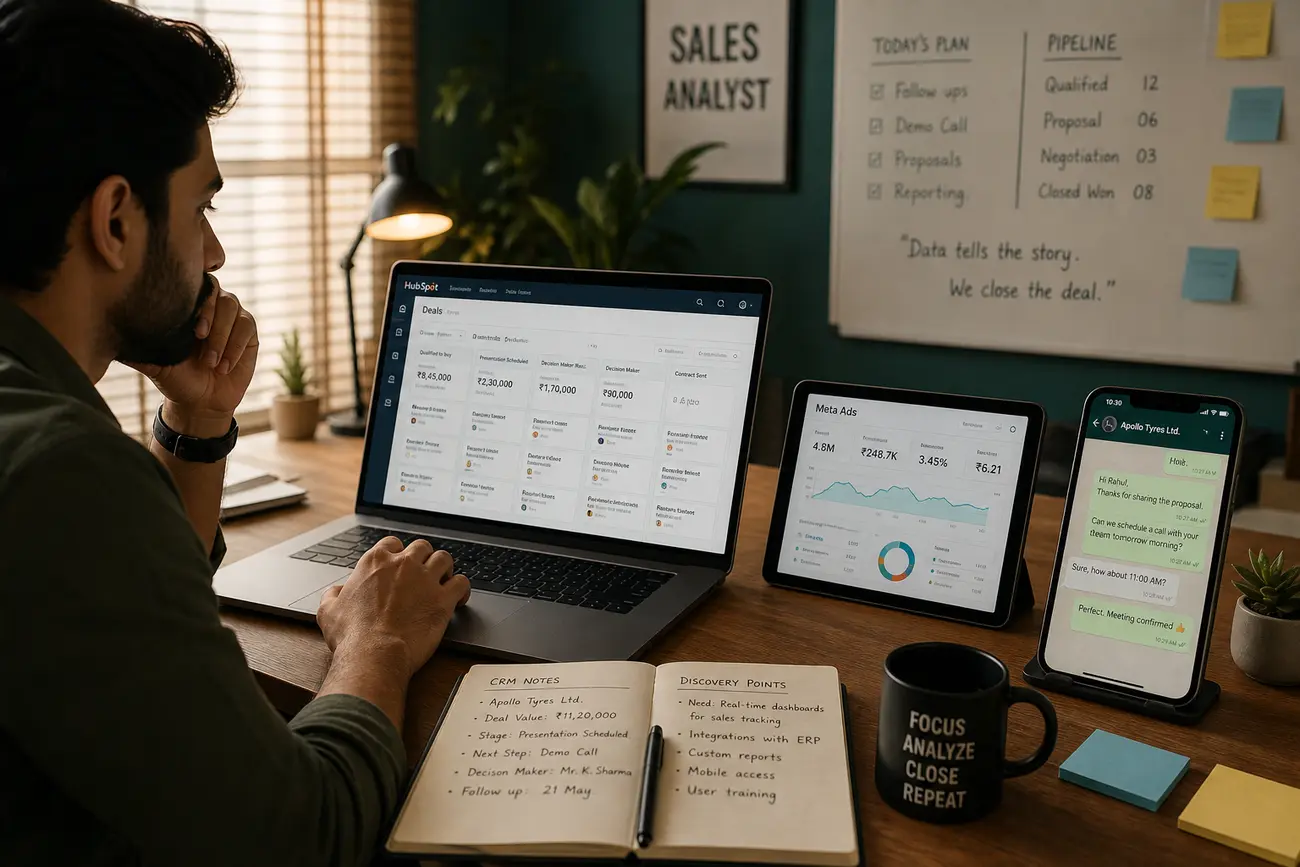
Lead performance is the difference between campaigns that collect cheap form fills and campaigns that create sales-ready opportunities. When you connect ad data, website behavior, WhatsApp conversations, and CRM outcomes, you can see which sources actually produce qualified conversations, pipeline, and revenue.
What Lead Performance Really Means for Campaign ROI
Lead performance measures the quality and sales outcome of the leads generated by each campaign, not just the number captured. A campaign with a low cost per lead can still be unprofitable if those contacts never answer, cannot buy, or do not match your ideal customer profile.
For SMBs, the useful view combines source, engagement, fit, speed-to-contact, pipeline stage, and revenue outcome. A prospect is a potential buyer, a lead has shown identifiable interest or shared contact details, a qualified lead matches your criteria, and an opportunity is a real sales conversation with potential value.
One quick terminology note: “to lead someone on” means to make someone believe there is interest or commitment when there may not be. The correct past form is “led on,” as in “being led on.” In marketing, avoid “leading buyers on” with offers that attract clicks but create poor-fit leads.
The Data You Need Before AI Can Judge Lead Quality
AI cannot judge lead quality from ad clicks alone. It needs connected data from the ad platform, landing page forms, website behavior, WhatsApp chats, call records, email engagement, and CRM outcomes. UTM parameters and campaign IDs are essential because they connect each person back to the keyword, ad, campaign, and landing page that created the inquiry.
The most important CRM fields are lifecycle stage, lead owner, first response time, qualification status, deal value, close probability, and lost reason. Standardize lead statuses such as new, contacted, qualified, disqualified, sales-accepted, opportunity, won, and lost so AI can compare campaigns consistently.
If irrelevant search questions appear in your data, classify them by intent instead of treating them as sales-ready. For example, “Are there hydroponic stores in Grand Rapids, Michigan?” or “Where can I find hydroponic stores in Kansas City?” are local-store intent; “What should a beginner buy at a grow shop?” is beginner-product intent; and “Where can I find deals on hydroponic garden supplies?” is discount intent.
How to Connect Ads, WhatsApp, and CRM Data Into One Lead View
The ideal flow is simple: a buyer clicks an ad, visits a landing page, submits a form or starts a WhatsApp chat, and a CRM record is created with the original source attached. For a deeper setup guide, see Connect Your Website, Ads, and WhatsApp Into One Lead System.
WhatsApp messages add intent signals that forms often miss: urgency, budget, objections, location, product interest, and buying timeline. Syncing chats, notes, calls, follow-ups, and outcomes into the CRM gives AI a richer view of lead performance.
Deduplication matters. If the same buyer clicks an ad, sends a WhatsApp message, and later fills out a form, count that person as one lead with multiple touchpoints, not three separate leads.
A Practical Lead Evaluation Framework for SMB Campaigns
A useful lead evaluation model scores each lead across five areas: fit, intent, engagement, timing, and commercial value. It should be simple enough for sales teams to trust and structured enough for AI to apply consistently.
- Fit: company size, location, industry, role, need, and budget.
- Intent: demo requests, pricing-page views, repeat visits, and specific WhatsApp questions.
- Engagement: fast replies, opened emails, answered calls, and booked meetings.
- Timing: immediate need versus vague future interest.
- Value: expected deal size, margin, repeat purchase potential, or contract length.
Compare campaign quality using qualified lead rate, sales-accepted lead rate, opportunity rate, and close rate. These metrics show whether volume is turning into real pipeline.
The Benefits of Lead Scoring With AI
The main benefits of lead scoring are faster prioritization, better follow-up, cleaner sales handoff, improved budget allocation, and less time wasted on poor-fit inquiries. Instead of treating every form fill equally, sales can call the strongest leads first while marketing learns which campaigns deserve more budget.
AI improves lead performance by finding patterns humans often miss. It can identify WhatsApp phrases, objections, response times, page visits, or source combinations that correlate with closed deals. Predictive scoring then ranks new leads based on historical CRM outcomes.
AI should support sales judgment, not replace it. A salesperson may know that a low-scoring lead has strategic value, or that a high-scoring lead is not serious. The best systems combine machine learning with human feedback.
Campaign Metrics That Reveal Real Sales Opportunities
A strong lead performance dashboard separates volume metrics from quality metrics. Track leads, cost per lead, and conversion rate, but also track cost per qualified lead, cost per opportunity, pipeline value by campaign, win rate by source, and revenue per campaign.
This prevents bad optimization decisions. One campaign may look expensive because it produces fewer leads, yet those leads may book more calls, reach opportunity stage faster, and close at higher deal values. Another keyword may generate cheap inquiries but mostly unqualified conversations.
The goal is not to buy the lowest-cost leads. The goal is to invest in the campaigns that create the highest-quality sales opportunities at an acceptable acquisition cost.
How to Build an AI-Ready Lead Performance Dashboard
Build your dashboard around the full buyer journey: acquisition source, lead behavior, conversation quality, CRM stage, sales outcome, and revenue impact. For teams using chat as a primary response channel, WhatsApp Website Integration for Faster Lead Follow-Up can help reduce response gaps that damage conversion.
Review the dashboard weekly with practical questions: which sources produce qualified leads, where do leads drop off, which follow-ups improve conversion, and which lost reasons repeat by campaign? Train AI on closed-won and closed-lost patterns, but monitor for outdated assumptions or bias.
- Audit campaign tracking and UTMs.
- Clean CRM fields and lead statuses.
- Connect WhatsApp, calls, forms, and email activity.
- Define lead scoring rules with sales input.
- Review campaign quality monthly, not only cost per lead.
FAQ
Which comes first, prospect or lead?
A prospect usually comes first. A prospect is a potential buyer who fits your market. A lead is a prospect who has shown identifiable interest, such as submitting a form, starting a WhatsApp chat, calling, or sharing contact information.
What are the 5 P's of prospecting?
A practical version of the 5 P’s is purpose, preparation, personalization, persistence, and process. Together, they help sales teams contact the right people with relevant messaging and consistent follow-up.
What is lead evaluation?
Lead evaluation is the process of judging whether a lead is a good fit and likely to become a real sales opportunity. It looks at need, budget, authority, timing, engagement, and expected commercial value.
What are the main benefits of lead scoring?
The main benefits of lead scoring are better prioritization, faster response, higher conversion, cleaner marketing-to-sales handoff, and smarter budget allocation toward campaigns that generate qualified pipeline.
How can AI improve lead performance?
AI improves lead performance by combining campaign, behavior, conversation, and CRM data to identify which leads and sources are most likely to produce revenue. It helps teams act faster and optimize campaigns based on sales outcomes, not vanity metrics.
Share Article
Your Digital Edge, Fully Automated
Spin up a cutting-edge website in minutes and preview it free - no signup, no credit card. Then keep growing it with MR.ROBOT's AI pipeline that writes, optimizes, and publishes SEO articles straight from your phone.
No signup. No credit card. You only pay when you love the result.