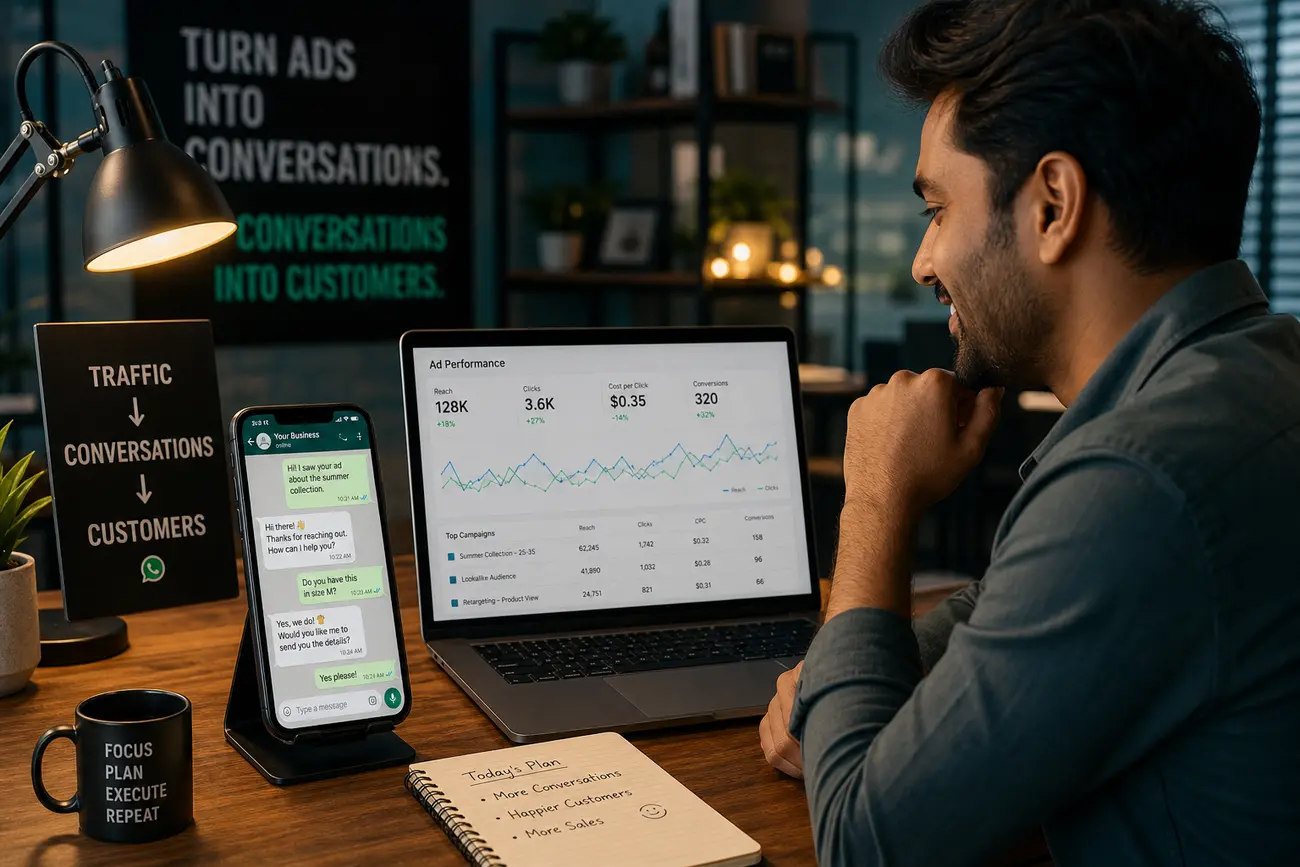
An AI agent for ecommerce can turn the daily chaos of product updates, support tickets, stock checks, and campaign reporting into faster, repeatable workflows. If you run an online store, the goal is not to replace your judgment; it is to remove the manual work that slows you down so you can focus on products, customers, margins, and growth.
What an AI agent for ecommerce can actually do for an online store
An AI agent for ecommerce is a connected system that can read store data, follow business rules, recommend actions, and automate repetitive ecommerce workflows. It can help with product content, customer support, inventory planning, order routing, marketing campaigns, and reporting.
A simple chatbot usually answers questions in a chat window. An AI tool for ecommerce may solve one task, such as writing product descriptions or summarizing reviews. A more advanced AI agent works across multiple areas: it can draft product copy, tag support tickets, flag low-stock products, recommend reorder quantities, and create customer segments from purchase behavior.
Realistic expectations matter. AI can reduce manual work and improve speed, but store owners still need strategy, brand guidelines, quality control, pricing decisions, supplier oversight, and financial discipline. Practical AI in ecommerce examples include rewriting weak supplier descriptions, classifying refund requests, forecasting reorder points, and identifying VIP customers for retention campaigns.
Use AI to create better product content faster
Product content is one of the best places to start with an AI agent for ecommerce because it is repetitive, high-impact, and easy to review before publishing. AI can create first drafts of product titles, descriptions, bullet points, FAQs, size guides, comparison copy, collection page text, and SEO metadata.
For better results, feed the system clear inputs: product specifications, materials, dimensions, use cases, customer reviews, competitor positioning, target audience, brand voice, prohibited claims, and compliance requirements. A generic prompt produces generic copy; a detailed product brief produces content that is more useful and more likely to convert.
- Human review: Check accuracy, claims, tone, uniqueness, and whether the copy truly differentiates the product.
- Dropshipping use case: Turn supplier descriptions into original, branded product pages instead of copying the same text used by dozens of stores.
- Localization: Adapt listings for different markets, currencies, sizing norms, and customer expectations.
If search visibility is part of your growth plan, connect product content workflows with modern search strategy. For broader context, see this guide to SEO, GEO, and AEO in AI search marketing.
Automate customer support without losing the human touch
An AI agent for ecommerce can answer common customer questions about shipping times, returns, sizing, product compatibility, order status, warranty terms, and store policies. The biggest benefit is faster first response time and fewer repetitive tickets for your team.
Set clear triage rules. AI can handle routine questions, suggest answers for agents, summarize conversation history, and tag tickets by urgency. It should escalate refund disputes, angry customers, payment issues, damaged goods, suspected fraud, and high-value orders to a human.
- Good automation: “Where is my order?”, “What size should I choose?”, “Do you ship to my country?”
- Needs human review: chargebacks, legal threats, missing expensive items, repeated complaints, and exception requests.
The best support automation feels consistent, not robotic. Keep your policy answers updated, allow customers to reach a person, and review AI conversations weekly to catch gaps before they affect trust.
Improve inventory, order management, and fulfillment decisions with AI
Inventory is where AI can protect cash flow. An AI agent for ecommerce can analyze sales history, seasonality, supplier lead times, ad campaigns, margin data, and stockout patterns to suggest reorder quantities or warn when a product is likely to run out.
What is the best order management software for e-commerce? There is no universal winner. The right choice depends on store size, sales channels, order volume, warehouse setup, supplier network, shipping integrations, returns process, and the depth of automation you need.
- Real-time stock sync across channels
- Multichannel order routing
- Returns and exchange management
- Supplier and purchase order updates
- Shipping carrier integrations
- AI-powered demand forecasting and stock alerts
For AI dropshipping Shopify setups, automation can monitor supplier feeds, route orders, flag unavailable products, and alert you when fulfillment times change. Still, do not let automation hide supplier problems. Test samples, monitor delivery times, and track refund reasons.
Turn marketing campaigns into sales automation
Marketing is another area where an AI agent for ecommerce can convert scattered data into action. AI can segment customers by browsing behavior, order history, lifetime value, abandoned carts, discount sensitivity, category interest, and repeat purchase likelihood.
- Email flows for new customers, cart abandoners, and repeat buyers
- SMS reminders for time-sensitive offers
- Product recommendations and upsells
- Win-back campaigns for inactive customers
- Ad creative testing and audience briefs
- Promotion planning based on stock levels and margins
The point is not just to send more messages. The point is to improve conversion rate, average order value, repeat purchase rate, and cost per acquisition. Practical AI in ecommerce examples include generating campaign variations, identifying products to promote before overstock becomes a problem, and preparing better briefs for paid media. If paid search is important to your store, this guide on how to improve Google Ads campaigns with an AI agent is a useful next step.
Choosing the right AI ecommerce stack: tools, CMS, and integrations
Which CMS is best for ecommerce? It depends on your business model. Shopify is often strong for speed, hosted commerce, and its app ecosystem. WooCommerce works well when you want WordPress flexibility. BigCommerce offers many built-in commerce features. A headless CMS can be best for custom experiences, but it usually requires more technical resources.
When evaluating any AI tool for ecommerce, look for native integrations, safe data access, workflow automation, privacy controls, reporting, support quality, pricing clarity, and the ability to fit your existing stack. Avoid buying five tools before proving one workflow saves time or increases revenue.
Searches for an AI dropshipping app or AI dropshipping builder often promise speed, but automation does not fix weak suppliers, thin margins, slow shipping, poor product-market fit, or unclear refund policies. Verify supplier quality, order samples, understand total costs, and build a brand customers can trust.
A realistic implementation plan for store owners
The safest way to adopt an AI agent for ecommerce is to start with one bottleneck. Choose the area that wastes the most time or creates the most mistakes: product content, support, inventory, order management, or marketing automation.
- Week 1: Audit repetitive tasks and choose one workflow to improve.
- Week 2: Document brand voice, business rules, approval steps, and data permissions.
- Week 3: Test AI on a small sample, such as 20 products or 50 support tickets.
- Week 4: Review quality, measure time saved, fix errors, and decide whether to scale.
Use guardrails: prompt templates, approval workflows, restricted permissions, performance dashboards, and weekly quality checks. Free AI tools can help with planning and drafts, but serious ecommerce usually requires budget for platform fees, apps, product samples, creatives, ads, a domain, and working capital. AI is not a shortcut to guaranteed profit; it helps disciplined operators move faster and make better decisions.
FAQ
Does AI dropshipping actually work?
Yes, AI dropshipping can work when AI supports product research, product content, customer support, and operations. Profit still depends on margins, supplier reliability, traffic quality, conversion rate, shipping experience, and execution.
Can we do AI dropshipping?
Yes. Store owners can use AI for dropshipping workflows such as listing creation, supplier feed monitoring, support drafts, and campaign planning. Human oversight is still needed for supplier selection, branding, compliance, refunds, and customer service.
How much money do I need to start AI dropshipping?
Costs vary by market and strategy. A lean test may require a few hundred dollars for a domain, platform fees, apps, samples, creatives, and basic ads. A more serious launch can require more for inventory testing, professional design, stronger tools, and paid traffic.
Can you start AI dropshipping with no money?
You can use free AI tools for research, planning, and content drafts, but launching and validating a real store usually requires at least some budget. You will likely need to pay for a platform, domain, samples, apps, and traffic.
What is an eCommerce accelerator?
An eCommerce accelerator is a program, service, or platform designed to help ecommerce businesses grow faster through training, systems, mentorship, tools, services, funding, or operational support.
Is an eCommerce accelerator legit?
Some are legitimate and useful; others overpromise. Check reviews, real client results, contract terms, refund policies, founder credibility, support quality, and whether the offer promises unrealistic guaranteed income.
Who is the founder of ECOM Accelerator?
There are multiple businesses and programs using similar names, so the founder depends on the specific company or course you mean. Check the official website, legal business records, LinkedIn profiles, and verified social accounts before trusting any claim.
Is eCommerce a legit way to make money?
Yes, ecommerce is a legitimate business model, but it is not easy money. Success requires product-market fit, reliable operations, marketing skill, customer trust, healthy margins, and cash-flow management.
What is the best order management software for e-commerce?
The best order management software depends on your sales channels, order volume, warehouse setup, integrations, returns process, and automation needs. Choose based on fit, not popularity alone.
Which CMS is best for ecommerce?
Shopify is often best for fast setup, WooCommerce for WordPress flexibility, BigCommerce for built-in commerce features, and headless CMS platforms for custom experiences. The best choice is the one that matches your team, budget, catalog, and growth plan.
Share Article
Your Digital Edge, Fully Automated
Spin up a cutting-edge website in minutes and preview it free - no signup, no credit card. Then keep growing it with MR.ROBOT's AI pipeline that writes, optimizes, and publishes SEO articles straight from your phone.
No signup. No credit card. You only pay when you love the result.