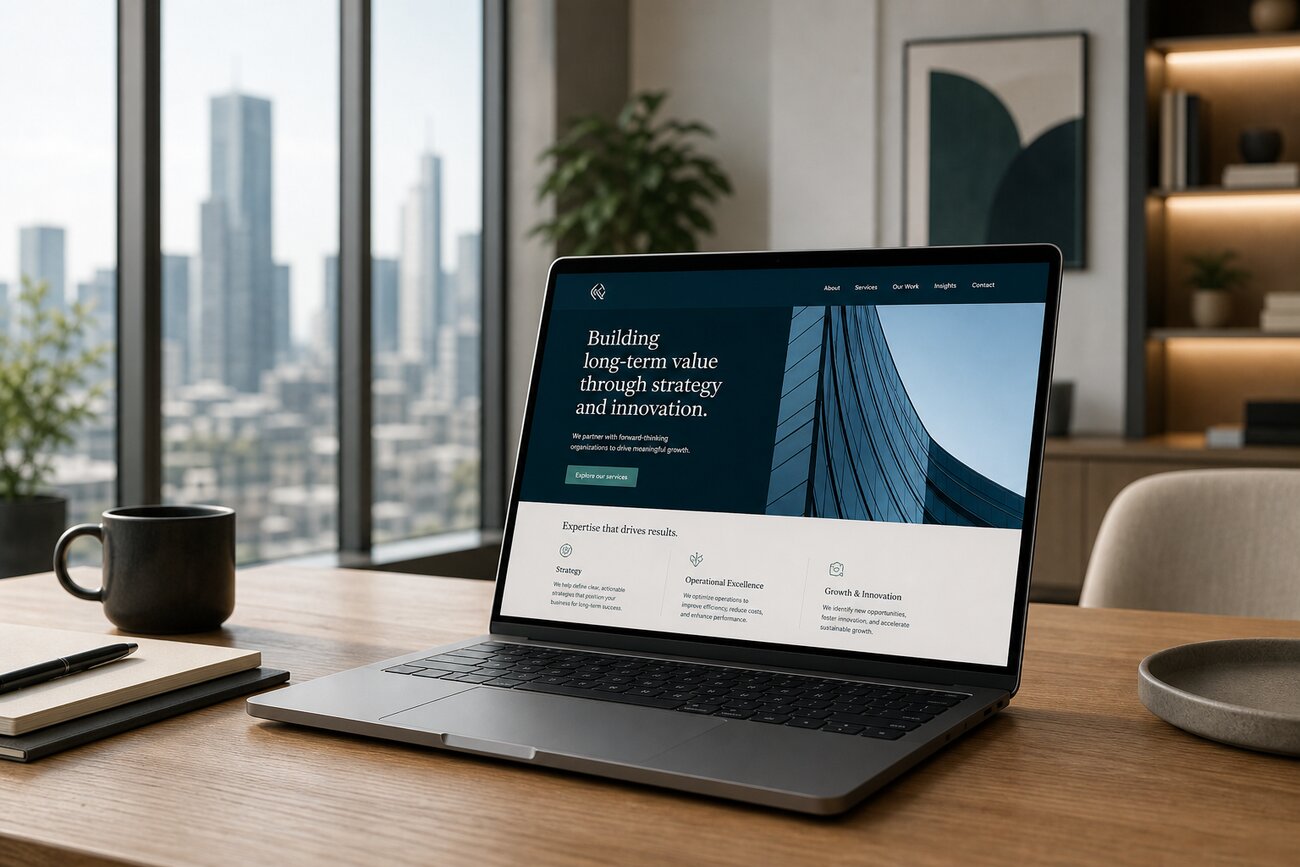
A strategic website does more than present information. It reduces uncertainty. Before a buyer books a call, requests a quote, or shares their details, they are asking whether your business feels credible. A skilled web design agency understands that trust is not a decorative layer added at the end. It is the commercial foundation of the entire site experience.
Why a Web Design Agency Thinks About Trust Before Visual Style
Professional web design begins with business credibility, not decoration. Colour palettes, imagery, animation, and layouts matter, but only when they support a clear commercial purpose. If a website looks attractive but fails to reassure visitors, it has missed the point.
A web design agency translates brand values such as reliability, expertise, and clarity into visible trust signals. That might mean sharper messaging, stronger page structure, clearer service explanations, or more confident proof. Strategic design answers the questions visitors rarely say out loud: Is this company legitimate? Do they understand my problem? Can they solve it without wasting my time?
First Impressions Online Are Fast, Emotional, and Design-Led
Online credibility judgments happen quickly. Within seconds, visitors respond to layout, polish, hierarchy, navigation, and overall visual control. They may not consciously analyse these elements, but they feel the difference between a business that appears organised and one that feels uncertain.
Poor design creates friction before prospects even read the offer. Crowded pages, inconsistent spacing, dated visuals, or confusing menus make people work too hard. That effort creates doubt. In contrast, a well-structured website tells visitors that the company behind it is professional, stable, and attentive to detail.
Visual quality also signals operational quality. Buyers often assume that if a company has invested in a clear, modern website, it is more likely to deliver a clear, professional service.
The Trust Signals Visitors Evaluate Without Realizing It
Many trust signals are evaluated silently. Load speed tells visitors whether the experience is smooth or frustrating. Mobile responsiveness shows whether the business understands modern buying behaviour. Consistent spacing, readable typography, and intuitive navigation all suggest control and care.
Social proof is another major factor, but placement matters. Testimonials, client logos, reviews, case studies, and measurable outcomes should appear where they support a decision, not as afterthoughts buried at the bottom of a page. A strong service page, for example, should combine the problem, the solution, the process, and evidence that the solution works.
Trust is also built through the absence of doubt. No broken links. No slow pages. No unclear forms. No confusing next steps. Every small obstacle gives a cautious buyer another reason to leave.
How Website Templates Can Accelerate Credibility When Used Strategically
Website templates can be a smart foundation when they are customized around brand positioning. For many businesses, they provide a practical way to move faster without starting from a blank screen. Modern templates often include proven page structures, responsive layouts, and familiar content patterns that already support usability.
The risk comes when website templates are used without adaptation. A template that is not shaped around your message, audience, and proof can make the business look generic. Visitors may feel they have seen the same site before, which weakens memorability and trust.
The best use of website templates is strategic, not cosmetic. Keep the structural advantages, then refine the copy, imagery, calls to action, and proof points so the site feels specific to your business.
Using Website Design Inspiration Without Looking Like Everyone Else
Website design inspiration is useful because it shows what modern buyers now expect. Reviewing strong sites helps you understand current standards for layout, messaging, navigation, and presentation. It also reveals how competitors position themselves, which is essential if you want to stand out.
The goal is not to copy. Website design inspiration should help identify trust-building patterns: clear hero messaging, focused service pages, proof-led sections, simple comparison points, and calls to action that are easy to find. These patterns work because they reduce uncertainty and help visitors make decisions.
Differentiation comes from strategy. Website design inspiration can guide direction, but your brand strategy determines distinctness. Your market position, customer insight, tone of voice, and evidence should shape the final experience.
Strategic Design Converts Skepticism Into Clear Next Steps
Most prospects arrive with some level of skepticism. They want to know what you do, who you help, why you are credible, and what happens if they take the next step. A trustworthy website makes the offer, value proposition, and next action immediately clear.
Content hierarchy plays a major role. The page should guide visitors from awareness to confidence and then to conversion. That means leading with relevance, supporting the claim with proof, explaining the process, addressing common objections, and making the next step feel low risk.
Strong calls to action do not need to be aggressive. In many B2B environments, helpful language works better than pressure. “Book a consultation,” “Request an assessment,” or “Talk to an expert” can feel reassuring when the surrounding content has already built confidence.
The Hidden Cost of an Unstrategic Website
A weak website does not simply sit there doing nothing. It actively leaks leads and weakens brand credibility. Every unclear message, slow page, dated design choice, or unsupported claim gives potential customers a reason to hesitate.
In competitive markets, hesitation is expensive. Visitors often choose the company whose website feels more professional, more relevant, and more reassuring. That does not always mean the better business wins. It means the business that communicates trust more effectively wins the opportunity.
Investing in strategic web design protects revenue, reputation, and customer confidence. The right web design agency will not begin with the question, “How should this look?” It will begin with, “What must visitors believe before they are ready to act?”
Share Article
Your Digital Edge, Fully Automated
Spin up a cutting-edge website in minutes and preview it free - no signup, no credit card. Then keep growing it with MR.ROBOT's AI pipeline that writes, optimizes, and publishes SEO articles straight from your phone.
No signup. No credit card. You only pay when you love the result.