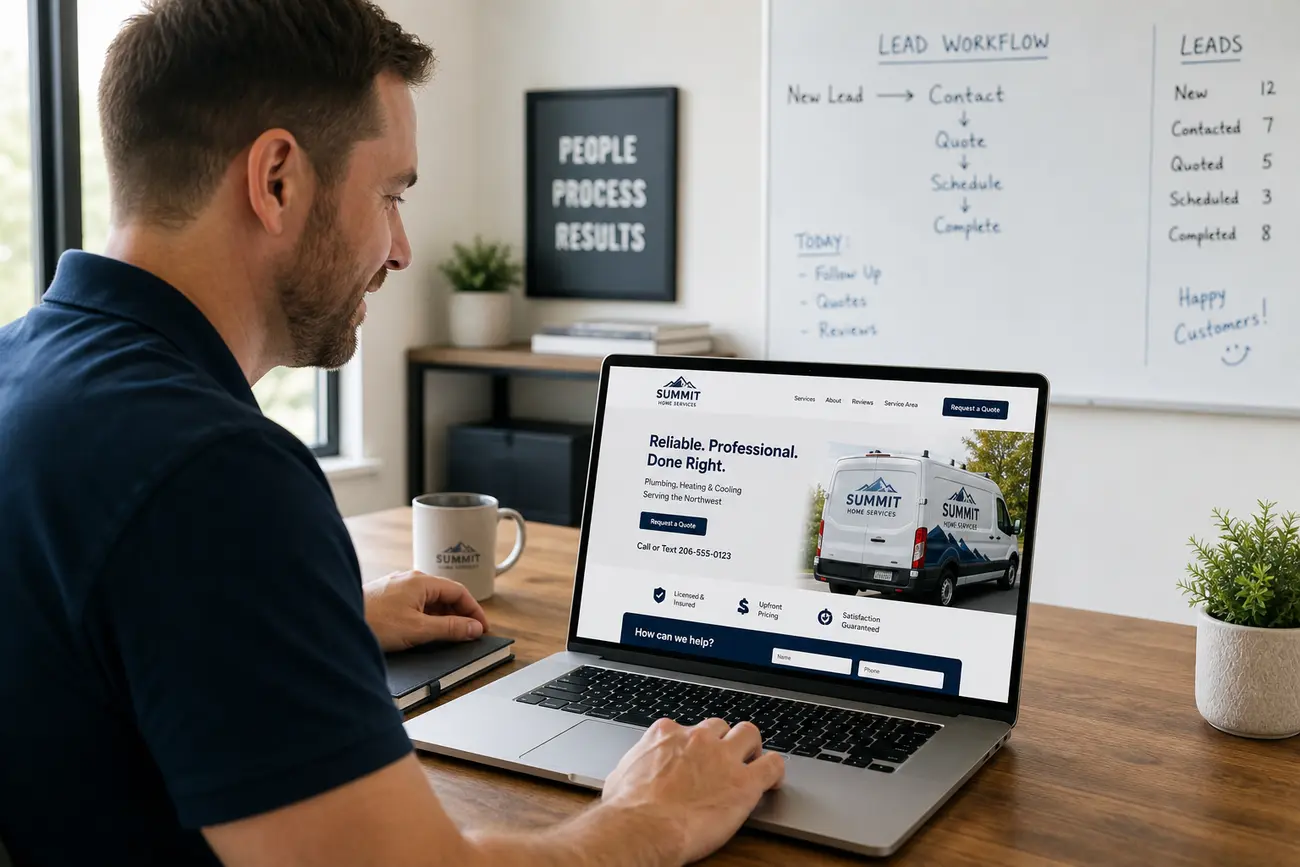
A small business website should not be treated like a digital brochure; it should work like a 24/7 sales assistant that attracts the right visitors, answers their questions, filters poor-fit enquiries, and turns serious buyers into real leads. If you run a service business, the goal is not simply to “look professional” online; it is to help potential customers understand why you are the right choice and make it easy for them to take the next step.
Start with the goal of your small business website: qualified leads
A qualified lead is not just anyone who fills out a form. For a service business, a qualified lead usually has the right problem, is in your service area, has a realistic budget, needs help within a suitable timeframe, and is a good fit for how you work.
Your website’s job is to answer buyer questions before people contact you. Visitors want to know what you do, whether you serve their location, how the process works, what kind of results you deliver, and whether they can trust you. A strong small business website reduces uncertainty before the enquiry happens.
Choose one primary conversion action, such as “Request a Quote,” “Book a Call,” or “Message Us on WhatsApp,” and one secondary action for visitors who are not ready yet. Every page should guide people toward a measurable next step: a call, form submission, WhatsApp message, booking request, quote request, or consultation.
Essential pages every service business website needs
The homepage should immediately state what you do, who you help, where you work, and why someone should choose you. Visitors should not have to scroll or guess. The first screen should make your offer clear and point people toward your main call to action.
Service pages are where many leads are won. Instead of listing all services on one general page, create one dedicated page per core service. This helps each page match search intent and speak directly to a specific problem. For a deeper planning framework, see How to Build a Business Website That Generates Leads.
Your small business website should also include an About page, case studies or project pages, reviews or testimonials, FAQs, and a strong Contact page. The About page builds confidence with your story, credentials, team, values, and experience. Case studies show the client problem, your process, and the result. The Contact page should include phone, WhatsApp, form, service area, hours, map if relevant, and response-time expectations.
Website design for small business: make the next step obvious
Good website design for small business is not about adding decoration. It is about making the path to enquiry obvious. Place your primary CTA above the fold, such as “Request a Quote,” “Book a Call,” or “Message Us on WhatsApp.” The visitor should always know what to do next.
Keep navigation simple. Prioritize services, proof, pricing guidance, and contact options. Most local service leads browse from mobile phones, so your small business website should be mobile-first with tap-to-call, tap-to-message, and easy booking actions. Sticky mobile CTAs can work well when they help rather than interrupt.
Use clear headings, short paragraphs, bullets, and a clean visual hierarchy. Forms should ask only for the information needed to qualify the enquiry, such as service needed, location, timeline, and contact details. Fast loading, readable text, accessibility, and professional presentation all support trust.
Trust signals that make visitors feel safe to contact you
Visitors are often asking themselves, “Can I trust this business with my home, property, project, health, money, or time?” Your small business website needs to answer that question clearly. Show real reviews with names, locations, dates, star ratings, or platform references where possible.
Add certifications, licenses, insurance, guarantees, memberships, awards, or partner logos if they are relevant to the service. Use real photos of your team, vehicles, office, tools, completed work, or client results instead of relying only on generic stock images.
The best testimonials are specific. They mention the customer’s problem, what the experience was like, and the outcome. You can also build trust with local proof, such as neighbourhoods served, local project examples, and transparent process steps that explain what happens after someone enquires.
Calls to action, forms, and WhatsApp paths that convert
Your calls to action should match visitor readiness. “Get a Quote” works for urgent buyers. “Ask a Question” helps uncertain visitors. “Book a Consultation” suits higher-value or more complex services. Avoid weak labels like “Submit” when a clearer lead-generation action is available.
WhatsApp can be very effective on a service business website, especially for mobile users. Use click-to-chat links with a pre-filled message such as: “Hi, I’d like a quote for [service] in [location].” Different service pages can use different prompts so the message immediately reveals the visitor’s intent.
Offer contact choices without creating decision overload: call for urgency, WhatsApp for convenience, and a form for detailed requests. Add microcopy near forms explaining response time, what happens next, and whether there is any obligation. After submission, use a thank-you page or confirmation message to set expectations and encourage the next action, such as uploading photos or choosing a call time.
Professional website design elements that improve lead quality
Professional website design is not just a polished look. It improves positioning, trust, usability, and lead quality. A strong site says who the ideal customer is, what service area you cover, what project size you handle, and what you specialize in.
Pricing guidance can filter out poor-fit leads. You do not always need exact prices, but minimum fees, package ranges, or “starting from” language can help visitors self-qualify. Forms can also include qualifying questions about location, urgency, property type, budget range, and the service needed.
Build each service page around buyer intent: the problem or symptoms, the solution, your process, proof, FAQs, and a clear CTA. Comparison content can help buyers choose between options before they contact you. Objection-handling sections should address common concerns such as cost, disruption, timeframe, warranty, experience, and fit. If you also want AI tools to interpret your business accurately, read How to Help AI Engines Understand Your Business.
Tracking setup: know which pages and channels generate leads
A small business website cannot improve what it does not measure. Install analytics so you can monitor traffic sources, landing pages, engagement, and conversion paths. Track meaningful lead actions, including phone clicks, form submissions, WhatsApp clicks, email clicks, booking clicks, and quote requests.
Use thank-you pages or event tracking to separate real enquiries from casual page views. Connect forms to a CRM, spreadsheet, email automation, or pipeline tool so no lead is lost. Use UTM parameters for ads, email, social media, directory listings, and partner links so you can identify which campaigns produce qualified enquiries.
Do not measure lead volume alone. Review which enquiries become booked jobs or paying clients. Monthly data can show which pages need clearer CTAs, stronger proof, better service content, or simpler forms. Your website should keep improving based on what real visitors and real customers do.
FAQ
What should a small business website include to generate leads?
A lead-generating small business website should include clear service pages, trust signals, strong calls to action, easy contact options, phone and WhatsApp paths, FAQs, reviews, and tracking for every enquiry.
How many pages does a service business website need?
Start with a homepage, dedicated service pages, an About page, proof pages such as case studies or projects, a reviews page, FAQs, and a Contact page. As your business grows, add more service-area pages, comparison pages, and detailed resources.
Is WhatsApp useful on a service business website?
Yes. WhatsApp is useful when it uses click-to-chat links, pre-filled messages, and clear prompts. It is especially helpful for mobile visitors who want a fast, low-friction way to ask for a quote or send project details.
What makes professional website design different from a basic website?
Professional website design focuses on business outcomes, not just appearance. It improves positioning, trust, mobile usability, conversion paths, lead qualification, and tracking so the site supports revenue, not just visibility.
How do I know if my website is generating qualified leads?
Track calls, form submissions, WhatsApp clicks, bookings, traffic sources, and which enquiries become paying customers. A successful small business website should show not only how many leads arrived, but which pages and channels produced the best-fit clients.
Share Article
Your Digital Edge, Fully Automated
Spin up a cutting-edge website in minutes and preview it free - no signup, no credit card. Then keep growing it with MR.ROBOT's AI pipeline that writes, optimizes, and publishes SEO articles straight from your phone.
No signup. No credit card. You only pay when you love the result.