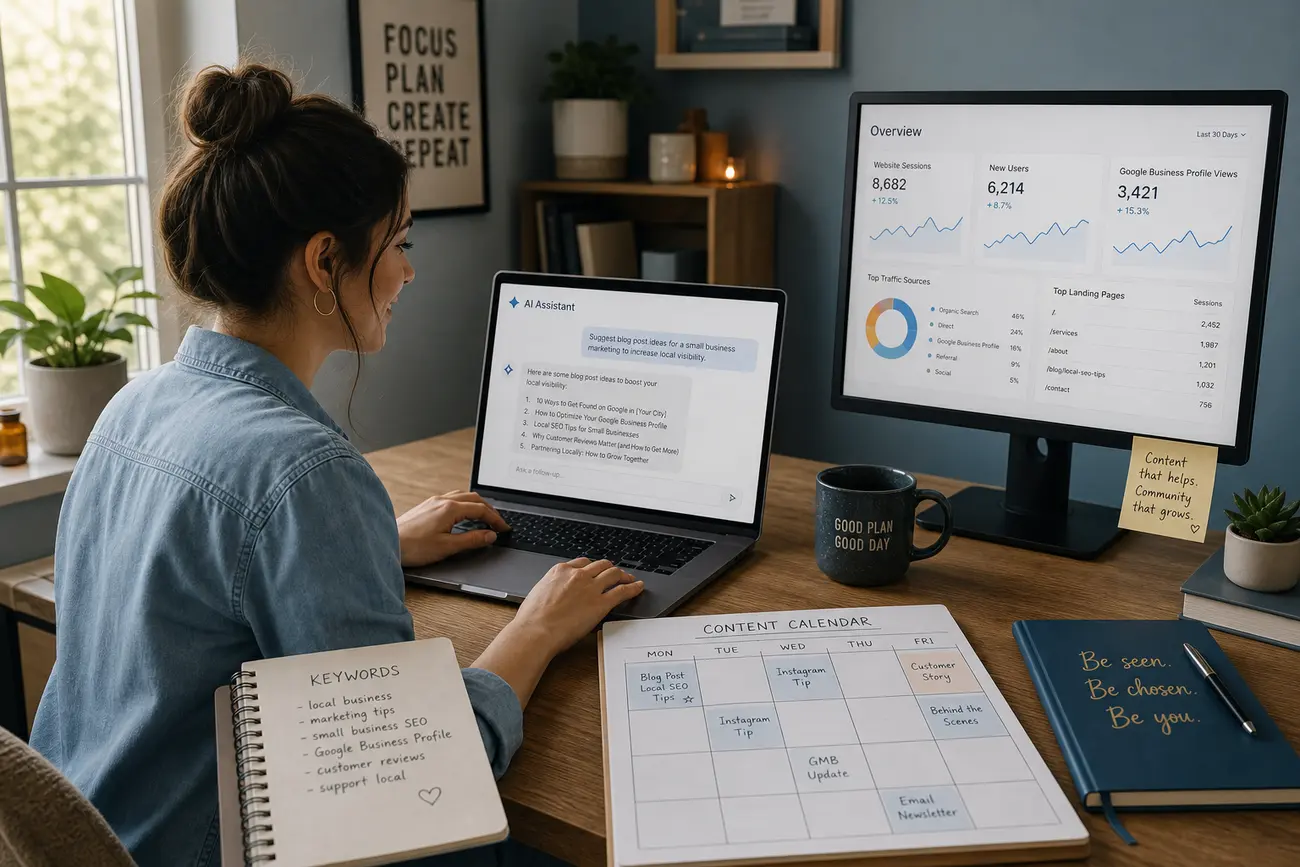
diy seo for small business is absolutely possible when you combine AI, a few simple tools, and a repeatable weekly workflow. You do not need a full SEO team to start earning more organic visibility; you need a clear system for choosing topics, improving pages, tracking results, and turning search traffic into leads.
DIY SEO for Small Business: What You Can Realistically Do Yourself
SEO includes keyword research, content planning, on-page optimization, local visibility, technical basics, and performance tracking. For most owners, diy seo for small business means improving the pages that already matter: your homepage, service pages, location pages, blog posts, Google Business Profile, and any landing pages that generate inquiries.
AI can speed up the work, but it should not replace your judgment. Use it to brainstorm keywords, cluster related searches, draft content outlines, improve title tags and meta descriptions, summarize search intent, and spot content gaps. Then add your expertise: pricing details, local knowledge, real customer questions, examples, photos, proof, and a clear offer.
SEO is a long-term organic growth channel. Google Ads can bring paid traffic quickly, but it does not replace SEO because traffic stops when the budget stops. A realistic weekly rhythm is two to four hours: research one topic, publish or update one page, review rankings and clicks, and improve internal links or calls to action.
Step 1: Set Up the Right SEO Software for Small Business
Start with the free essentials before paying for tools. Set up Google Search Console, Google Analytics 4, Google Business Profile, Bing Webmaster Tools, and Google Keyword Planner. These show how people find you, which pages get impressions, whether users convert, and how your business appears in local search.
Affordable seo software for small business becomes useful when you need rank tracking, site audits, keyword research, competitor comparisons, or content optimization. You do not need every platform at once. Pick tools that answer practical questions: What should I write next? Which pages are declining? What technical issues are blocking performance?
Use AI to turn raw keyword exports into topic clusters, search-intent summaries, and page briefs. Then build one simple dashboard that tracks clicks, impressions, rankings, leads, and conversions. Too many metrics create noise; diy seo for small business works best when you focus on the numbers tied to revenue.
Step 2: Use AI to Find Keywords Your Customers Actually Search
Begin with real customer language. Review sales calls, emails, reviews, competitor pages, Google autocomplete, related searches, and People Also Ask questions. Ask AI to group those ideas, but verify them with keyword tools and actual search results.
Group keywords by intent: informational, commercial, local, comparison, and transactional. For example, “how to fix a leaking pipe” is informational, while “emergency plumber near me” is local and transactional. Prioritize phrases that match your services, have achievable competition, and can become leads. One of the best small business seo tips is to stop chasing volume and start chasing qualified demand.
Use your primary keyword and supporting phrases naturally in titles, headings, introductions, URLs, image alt text, and internal links. If a keyword sounds awkward in a sentence, rewrite the sentence. Search engines reward clarity, not repetition.
Step 3: Build a Content Marketing Plan That Supports SEO
Content marketing is the process of creating useful content that attracts, educates, and converts a defined audience. In SEO, that content can include service pages, local guides, pricing explainers, checklists, comparison articles, case studies, FAQs, videos, and before-and-after examples. Does content marketing pay well? It can, when the content targets buyer intent and leads to measurable calls, forms, bookings, or sales.
Map content to the customer journey. Problem-aware visitors need helpful blog posts. Comparison shoppers need “best option” or “service vs. service” guides. Ready-to-buy prospects need strong service pages, proof, reviews, and clear next steps. For help improving what happens after visitors land on your site, see this guide to improving website conversion rates with AI and analytics.
Use the three C’s of content marketing as a planning filter: customer, content, and consistency. The 3-3-3 rule in marketing is a simple cadence: choose three audience problems, create three content formats, and share them through three distribution channels. For many small businesses, the best platform mix starts with Google Search, Google Business Profile, email, and one social channel your customers actually use.
Step 4: Optimize Each Page Before You Publish
Every page should have one clear title tag, meta description, H1, and URL that match search intent without keyword stuffing. The introduction should confirm the reader is in the right place, and the page should answer the main question quickly before adding detail.
Use H2 and H3 headings to answer specific questions, especially People Also Ask-style questions. Add internal links from related blog posts to service pages, and from service pages back to helpful guides. This helps users continue their journey and helps search engines understand which pages are most important.
Trust matters. Improve E-E-A-T by showing real experience: original examples, customer proof, team credentials, photos, screenshots, reviews, transparent pricing guidance, and easy contact information. Before publishing, check mobile usability, page speed, broken links, schema markup, and image compression. These small business seo tips prevent good content from being held back by avoidable friction.
Step 5: Decide When to Use Google Ads Alongside SEO
SEO and Google Ads serve different roles. SEO builds long-term visibility and authority, while Google Ads can generate immediate paid traffic. Ads are useful for high-intent offers, seasonal campaigns, and testing whether a keyword converts before you invest months into SEO content.
Is $10 a day enough for Google Ads? It can be enough for a small test in a low-competition market, but it may be too limited for expensive keywords or fast lead generation. Is $20 a day good for Google Ads? Often, yes, if the campaign is tightly targeted and conversion tracking is set up. How much does it cost to do a Google ad? Costs vary by keyword, location, competition, quality score, daily budget, and conversion rate.
Basic account tasks include Google Ads sign up, Google Ads login, using Google Ads Manager if you manage multiple accounts, checking campaign settings, and reviewing active ads. If you want to run paid search without a full-time campaign manager, this guide on managing Google Ads with AI is a useful next step.
Step 6: Track Results and Improve Your SEO Every Month
Monthly improvement is where diy seo for small business compounds. In Google Search Console, look for pages gaining impressions but getting low clicks. Improve their title tags and meta descriptions so they better match the searcher’s need.
Next, find pages ranking near the bottom of page one or on page two. Update them with stronger answers, fresher examples, better formatting, new internal links, and clearer calls to action. Track leads and sales, not just traffic, because the best SEO page is the one that produces business results.
Build a monthly checklist: fix technical issues, refresh old posts, publish one new content asset, review competitors, update your Google Business Profile, and summarize performance. AI can help identify trends and suggest next actions, but always verify recommendations against real analytics data.
FAQ
Is $10 a day enough for Google Ads?
Yes, $10 a day can be enough for small tests in low-competition markets. It is usually too limited for competitive industries, broad targeting, or fast lead generation.
Is $20 a day good for Google Ads?
$20 a day can be a useful starter budget if your campaign is tightly targeted, uses high-intent keywords, and tracks calls, forms, bookings, or purchases correctly.
How much does it cost to do a Google ad?
The cost depends on your keywords, location, competition, quality score, landing page, and daily budget. Start with a controlled test, then scale what produces profitable leads.
How do I find my Google Ads?
Log in to Google Ads or Google Ads Manager, open the campaign dashboard, and review active campaigns, ads, settings, billing, and performance reports.
What exactly is content marketing?
Content marketing is creating useful articles, guides, videos, emails, pages, and resources that attract, educate, and convert a specific audience.
How do I start content marketing for a small business?
Start with customer questions, choose a few core topics, publish helpful content consistently, and track which pages generate inquiries, calls, or sales.
What are the three C's of content marketing?
For small businesses, use customer, content, and consistency: know who you serve, create genuinely useful material, and publish on a sustainable schedule.
What is the best marketing platform for small businesses?
The best platform depends on your audience, but Google Search, Google Business Profile, email marketing, and one focused social channel are often the strongest starting mix.
Share Article
Your Digital Edge, Fully Automated
Spin up a cutting-edge website in minutes and preview it free - no signup, no credit card. Then keep growing it with MR.ROBOT's AI pipeline that writes, optimizes, and publishes SEO articles straight from your phone.
No signup. No credit card. You only pay when you love the result.