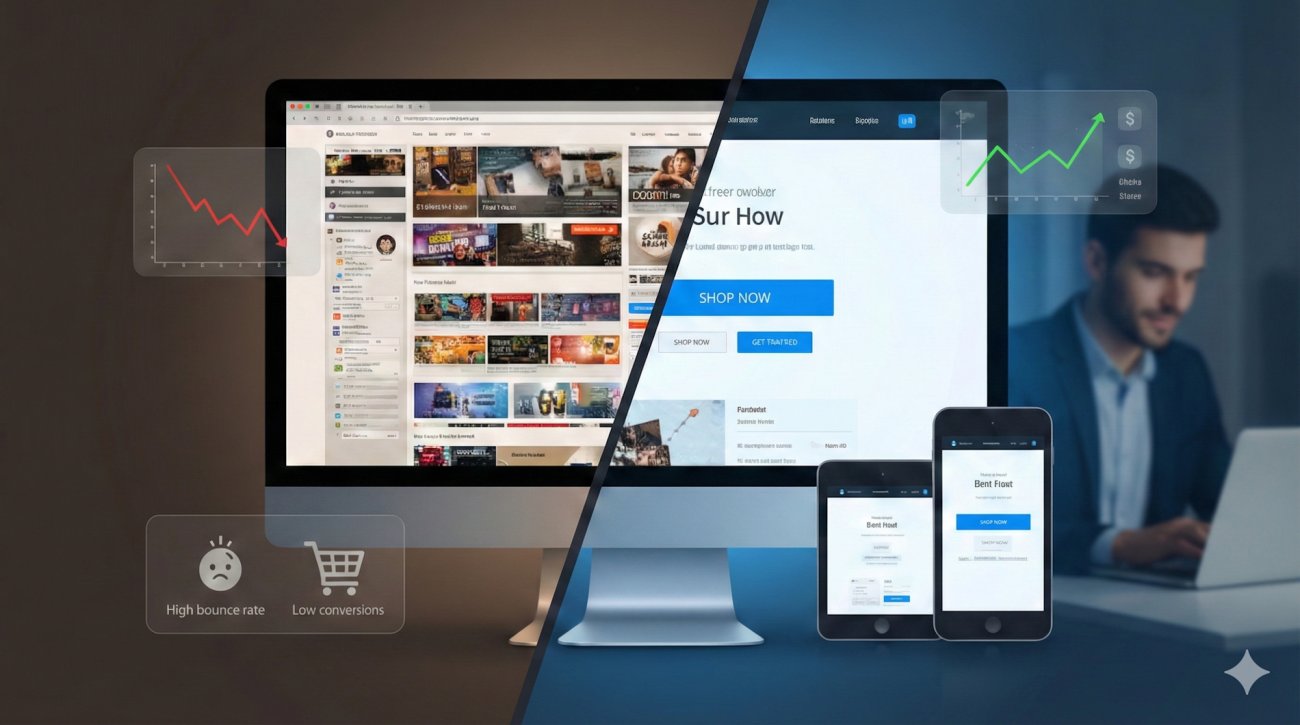
Website Redesign Strategy to Increase Sales Fast: Turning Traffic Into Revenue
If your website gets traffic but sales feel stuck, the issue is rarely “not enough visitors.” More often, the problem is that your site isn’t converting the visitors you already have. That’s why a website redesign strategy is one of the fastest ways to unlock growth—when it’s built for measurable outcomes, not just a new look.
A smart website redesign to increase sales focuses on what decision-makers care about: more qualified leads, higher close rates, lower cost per acquisition, and clearer proof of ROI of website redesign for small business. In this article, we’ll break down how to redesign a website to increase sales fast using a conversion-first approach that reduces friction, builds trust, and guides prospects to take action.
Why a Website Redesign Can Increase Sales Fast (When Done Right)
A redesign can be a growth lever because your website is your most scalable salesperson. It works 24/7, handles objections, explains value, and routes prospects to the next step. But if the site is unclear, slow, or confusing, it silently loses revenue every day.
A conversion-focused website redesign improves performance quickly because it targets the biggest “leaks” in your funnel:
- Clarity: Visitors immediately understand what you do, who it’s for, and why it matters.
- Trust: Proof (reviews, case studies, guarantees, certifications) reduces hesitation.
- Speed: Faster pages reduce abandonment and improve engagement.
- Friction reduction: Fewer steps to contact you, request a quote, book a call, or buy.
- Message-market fit: Your offers and positioning match what customers actually want.
This is the practical path to improve website conversion rate without necessarily spending more on ads or content.
Clear Signs Your Website Needs a Redesign for Higher Conversions
Not every site needs a full rebuild. But if you’re seeing any of the patterns below, a website redesign strategy aimed at conversions can pay off quickly.
- High traffic, low leads: People visit, but forms and calls stay quiet.
- High bounce rate: Visitors leave fast because the page doesn’t answer their questions.
- Mobile experience feels “second-class”: Hard to read, tap, or navigate on phones.
- Slow loading: Every extra second can reduce conversions and increase drop-off.
- Unclear differentiation: You sound like everyone else in your market.
- Sales team complaints: Leads are unqualified or don’t understand your offering.
- Hard to update: Marketing can’t move fast because the site is rigid.
These issues often lead to the same outcome: you need to reduce bounce rate and boost sales by improving clarity, credibility, and the path to action.
A Conversion-Focused Website Redesign Strategy (Built for Sales Outcomes)
A high-performing redesign is not “design-first.” It’s strategy-first. The goal is to align the website with how buyers actually decide—especially in competitive markets where attention is short and options are many.
Start with the buyer journey, not the sitemap
To increase leads and sales with a new website, map the steps your ideal customer takes:
- What problem triggers their search?
- What doubts do they have before contacting you?
- What proof do they need to trust you?
- What action are you asking them to take first?
This prevents a common mistake: organizing pages by internal departments instead of customer intent.
Define one primary conversion goal per page
If every page asks visitors to do five things, most will do nothing. A conversion-focused website redesign assigns a clear goal per page, such as:
- Request a quote
- Book a consultation
- Start a trial
- Call now
- Download a pricing guide
This is a direct way to improve website conversion rate because it reduces decision fatigue.
Reposition your message for speed and clarity
Your homepage has seconds to communicate value. Strong positioning is often the fastest fix when you’re figuring out how to redesign a website to increase sales fast. A practical formula:
- Who it’s for: “For [industry/role]…”
- What you deliver: “We help you achieve [result]…”
- How you’re different: “Using [approach/proof]…”
- Next step: “Book a call / Get a quote / See pricing…”
This is not copywriting “fluff.” It’s revenue clarity.
High-Impact Changes That Increase Conversions Quickly
When time-to-results matters, focus your redesign on the pages and elements that control conversion the most. These improvements are the backbone of a website redesign checklist for higher conversions.
1) Upgrade above-the-fold content to reduce bounce rate
To reduce bounce rate and boost sales, the top of each key page should immediately answer:
- What do you do?
- Who is it for?
- What result should I expect?
- What should I do next?
If visitors have to scroll to understand basics, you’re losing buyers who are ready now.
2) Make calls-to-action obvious and consistent
A common conversion killer is “soft” or inconsistent CTAs. In a conversion-focused website redesign, CTAs are:
- Visible without hunting
- Consistent in wording (e.g., “Book a Call” everywhere)
- Placed at natural decision points (not randomly)
- Supported by trust signals near the action
This simple discipline can significantly improve website conversion rate.
3) Add trust where people hesitate
Most prospects don’t need more features—they need reassurance. Add proof strategically:
- Short testimonials near CTAs
- Case studies that show before/after results
- Client logos (if allowed)
- Process steps (“What happens after you contact us”)
- Clear policies (delivery, warranty, support)
Trust is a core mechanism behind website redesign to increase sales, especially in higher-ticket services.
4) Improve mobile experience to capture “ready-to-buy” traffic
Many industries now see the majority of visits from mobile. If your mobile experience is hard to use, you’re paying for traffic that can’t convert. A website redesign checklist for higher conversions should include:
- Tap-friendly buttons
- Readable text without zooming
- Sticky call-to-action options (call, book, quote)
- Shorter forms with fewer required fields
Mobile optimization is often one of the fastest ways to increase leads and sales with a new website.
5) Use simplified navigation that supports decisions
Navigation should help buyers find answers fast. Too many menu items increases confusion. A conversion-first structure typically prioritizes:
- Core services (grouped logically)
- Industries or use cases (if relevant)
- Proof (case studies, testimonials)
- Pricing or “How it works”
- Contact / Book
This supports your overall website redesign strategy by reducing friction and keeping prospects moving.
Real-World Scenarios: Where Redesign Drives Immediate Sales Lift
Here are practical examples of how a website redesign to increase sales plays out in real business contexts.
Service business: more qualified leads, fewer wasted calls
A local or regional service provider (legal, accounting, HVAC, consulting) often gets leads that aren’t a fit. A conversion-focused website redesign can:
- Clarify who the service is for (and who it’s not for)
- Show pricing ranges or minimum project sizes (when appropriate)
- Introduce a short pre-qualification form
- Highlight proof and process to reduce “just shopping” inquiries
Result: fewer low-quality inquiries and more sales-ready conversations—an immediate way to increase leads and sales with a new website.
E-commerce: higher add-to-cart and checkout completion
For online stores, quick wins often come from reducing uncertainty and friction:
- Clear shipping/returns messaging
- Better product page structure (benefits, FAQs, proof)
- Streamlined checkout steps
- Mobile-first product browsing
These changes directly improve website conversion rate and can show results within days of launch.
B2B company: shorter sales cycles through better education
B2B buyers need confidence and internal justification. A redesign can support the sales team by:
- Explaining outcomes in business language (time saved, risk reduced)
- Providing downloadable one-pagers for internal stakeholders
- Publishing case studies with metrics
- Making “next steps” clear (demo, consultation, assessment)
This is a strong application of how to redesign a website to increase sales fast without changing your entire sales process.
How to Measure Success: ROI of Website Redesign for Small Business
Design that “looks better” is not a business metric. To prove ROI of website redesign for small business, define success before the first page is redesigned.
Key metrics to track before and after launch
- Conversion rate: percentage of visitors who become leads or customers
- Cost per lead: especially if you run ads
- Lead quality: fit, budget, readiness (sales feedback matters)
- Bounce rate: whether key pages retain attention
- Time to first action: how quickly visitors contact you
- Revenue per visitor: especially for e-commerce
When these improve, you’re not guessing—you’re validating that your website redesign strategy is working.
Set realistic expectations for “fast” sales impact
Many businesses see meaningful lift quickly if the redesign addresses obvious friction (unclear messaging, weak CTAs, poor mobile). However, the biggest gains often come in two phases:
- Phase 1 (fast wins): launch with improved structure, messaging, and conversion paths.
- Phase 2 (optimization): refine based on real user behavior and data.
This approach supports website redesign to increase sales while keeping risk controlled.
Website Redesign Checklist for Higher Conversions (Executive-Friendly)
Use this website redesign checklist for higher conversions to keep your project focused on outcomes.
- Business goals defined: leads, bookings, purchases, pipeline value
- Target audiences clarified: top 2–3 customer segments and their needs
- Top pages prioritized: homepage, service pages, product pages, contact, pricing
- Messaging updated: clear value proposition, differentiation, proof
- Conversion paths simplified: fewer steps, fewer form fields, clear CTAs
- Trust assets included: testimonials, case studies, guarantees, FAQs
- Mobile-first experience verified: navigation, forms, buttons, readability
- Speed and performance addressed: fast load times across devices
- Analytics in place: conversion tracking and lead source visibility
- Post-launch plan: 30–60 days of review and iteration
If you want to improve website conversion rate, this checklist helps prevent a common failure: spending budget on visuals while leaving conversion barriers untouched.
Going Beyond Design: Automation That Multiplies Conversion Gains
A redesign becomes even more powerful when paired with automation. This is where “Mr. Robot” typically sees the fastest operational ROI—because the website doesn’t just generate leads; it moves them forward automatically.
Examples of automation that increase sales speed
- Instant lead routing: send inquiries to the right team member based on service or location.
- Auto-responses that convert: immediate confirmation plus the next step (calendar link, questionnaire, pricing guide).
- CRM integration: every lead is captured, tracked, and followed up consistently.
- Qualification workflows: filter and prioritize high-intent leads.
- Abandoned checkout or inquiry follow-up: recover lost opportunities.
These systems support increase leads and sales with a new website by reducing manual work and ensuring no opportunity slips through the cracks.
Common Website Redesign Mistakes That Hurt Sales
Even well-funded projects can underperform if they miss the fundamentals. Avoid these pitfalls if your goal is website redesign to increase sales:
- Designing for internal opinions instead of customer behavior
- Launching without conversion tracking (you can’t manage what you can’t measure)
- Overloading pages with options instead of guiding one clear action
- Hiding pricing context when competitors are more transparent
- Ignoring mobile even when mobile is most of your traffic
- Delaying launch endlessly instead of shipping a strong version and optimizing
A practical website redesign strategy balances speed and quality: launch improvements, then iterate based on real data.
Conclusion: Build a Website That Sells—Not Just One That Looks Modern
A modern website is nice. A website that reliably converts visitors into leads and customers is a competitive advantage. The fastest path to growth is a conversion-focused website redesign that improves clarity, reduces friction, builds trust, and supports the next step in the buyer journey.
If you want to reduce bounce rate and boost sales, improve website conversion rate, and prove the ROI of website redesign for small business, the key is to treat redesign as a revenue project—not a design project.
Ready to increase sales fast? Mr. Robot can run a conversion and automation audit of your current site, identify the highest-impact fixes, and propose a practical redesign roadmap focused on measurable outcomes. If you’re considering how to redesign a website to increase sales fast, let’s discuss your goals and build a plan that turns traffic into revenue.
Share Article
Your Digital Edge, Fully Automated
Spin up a cutting-edge website in minutes and preview it free - no signup, no credit card. Then keep growing it with MR.ROBOT's AI pipeline that writes, optimizes, and publishes SEO articles straight from your phone.
No signup. No credit card. You only pay when you love the result.